





I’ve been sketching Medusa designs for three years now, ever since a client walked in asking for “something powerful but feminine.” She had no idea what she’d unleashed. That first Medusa piece — with flowing snakes that curved around her shoulder blade — opened a door to mythology I never knew existed in tattoo culture.
What started as one tattoo became an obsession. I’ve now designed dozens of Medusa pieces, each one teaching me something new about what makes this ancient symbol so compelling to modern women.
Where Medusa Tattoos Actually Come From
Most people think Medusa tattoos are just about Greek mythology. They’re wrong. The modern tattoo interpretation comes from three distinct movements that happened simultaneously around 2018-2019.
First, feminist reinterpretation of Greek myths gained serious traction in literature and art. Suddenly, Medusa wasn’t the monster — she was the victim turned powerful protector. This narrative shift hit tattoo culture hard. Women started requesting Medusa pieces as symbols of transformation after trauma, of finding strength in what others called monstrosity.
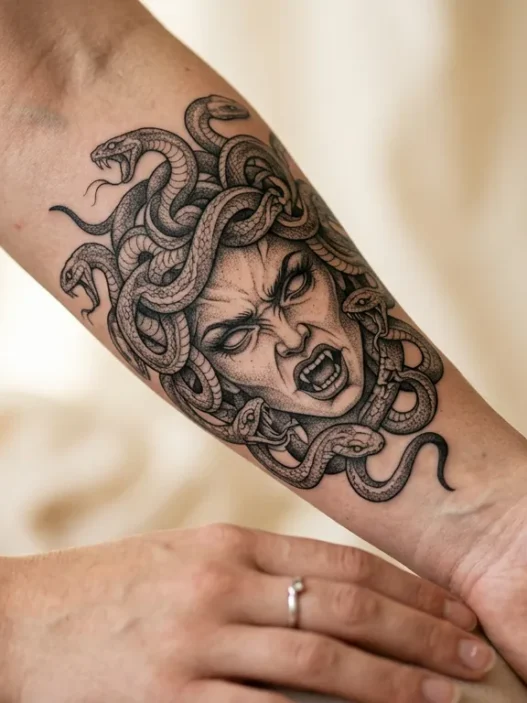
Second, fine line tattooing exploded. The delicate, detailed work that Medusa designs demanded became technically achievable for more artists. Those intricate snake scales, the subtle shading around her eyes — none of that was possible with traditional bold line work.
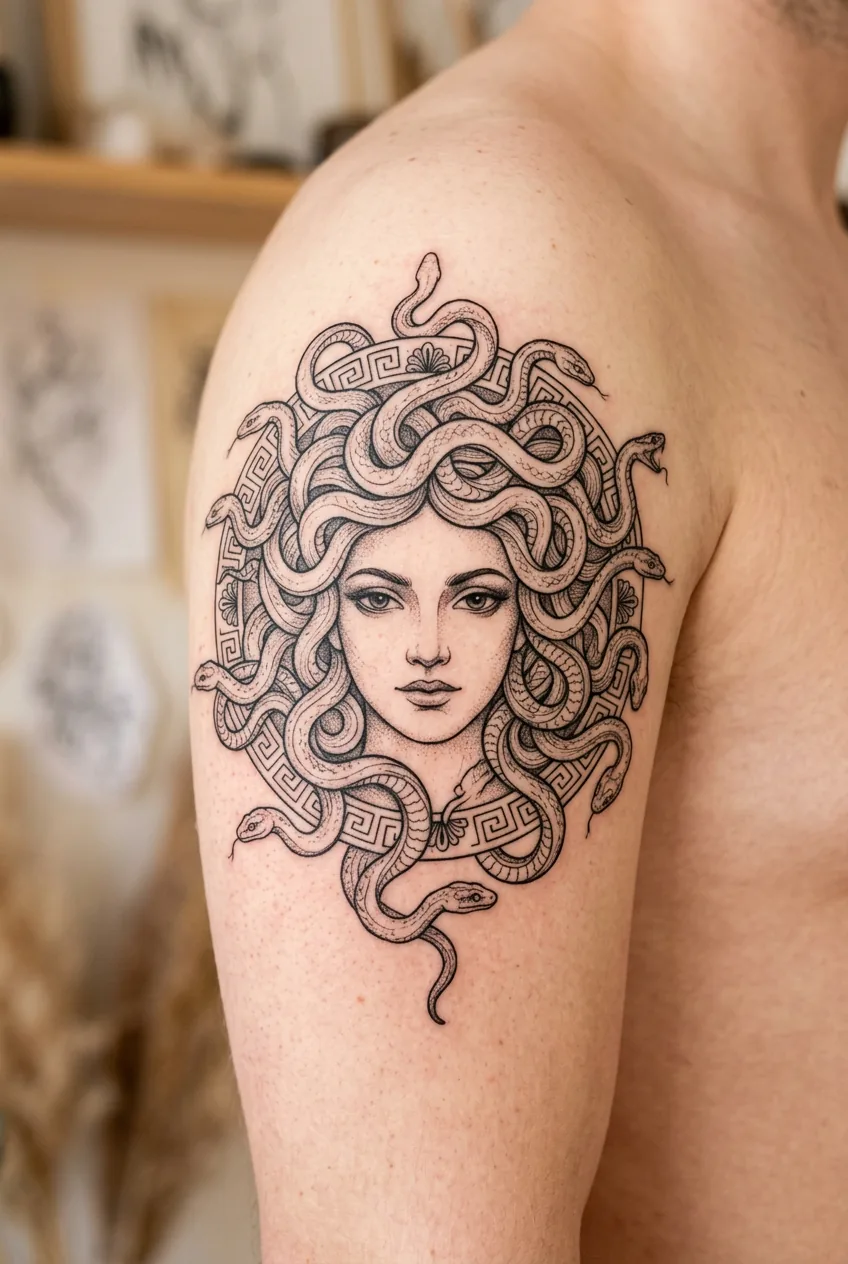
Third, social media created a visual language around “dark feminine” aesthetics. Medusa fit perfectly into this trend — beautiful but dangerous, classical but subversive. Instagram made these designs viral before most artists even understood what they were inking.
But here’s what fascinates me about the historical connection. Ancient Greek pottery shows Medusa with a much more human face than later Roman interpretations. The earliest depictions weren’t grotesque monsters — they were women with serpentine hair who looked almost serene. Modern tattoo artists are actually returning to these older, more humanized versions without realizing it.
The result? Medusa tattoos today capture something the ancients understood but medieval art forgot — that power and beauty aren’t opposites. They’re the same force expressed differently.
Why Face Direction Changes Everything
This is where most people mess up their Medusa tattoo before they even start. They focus on style, size, and placement but never consider which way her face should point. I learned this the hard way during my second Medusa piece.
A Medusa facing left (from the viewer’s perspective) reads as protective, watchful. She’s guarding against something approaching. This works beautifully on shoulder blades, the back of arms, or side ribcage — anywhere she can “watch your back” literally and figuratively.
Medusa facing right suggests forward movement, confrontation. She’s not defensive — she’s actively challenging whatever’s in front of her. These work best on forearms, where her gaze projects outward from your body, or on thighs where she faces toward your future steps.
Direct frontal Medusa — looking straight at the viewer — is the most intense option. It’s confrontational in the best possible way. But it requires perfect placement. On a forearm, she stares down anyone who looks at your tattoo. On your back, she becomes a shield. On your ribcage, she’s too hidden to have the intended impact.
The profile angle matters too. A three-quarter view (slightly turned) gives her more personality and allows for better snake arrangement. Full profile can look flat unless your artist really knows their anatomy. I’ve seen too many profile Medusas that look like they’re printed on rather than living within the skin.
Eye contact changes everything about the energy of the piece. Some clients specifically want her eyes closed or looking away — they prefer the symbolism without the direct confrontation. Others need that piercing gaze. Neither is wrong, but you need to decide before you sit down, not halfway through the session.
The Pricing Reality Nobody Posts About
Let’s talk money because nobody else will tell you the truth about Medusa tattoo costs. I’ve priced dozens of these, and the range will shock you.
A simple, small Medusa silhouette (palm-sized, black line work) starts around $200-300. But that’s not what most people want when they say “Medusa tattoo.” They want the snakes detailed, the face expressive, maybe some shading or color work. That immediately jumps to $400-600 for the same size.
Medium Medusa pieces (forearm-sized, 5-7 inches) with proper detail work run $800-1200. Here’s why: each snake requires individual attention. Good artists don’t copy-paste snake shapes — they design each one to follow the anatomy, to interact with the surrounding snakes, to create depth and movement. This takes time.
Large Medusa tattoos (shoulder to elbow, full back pieces) easily hit $2000-4000. I’ve seen artists charge $5000+ for full sleeve Medusas with elaborate backgrounds. The time investment is enormous — typically 15-25 hours across multiple sessions.
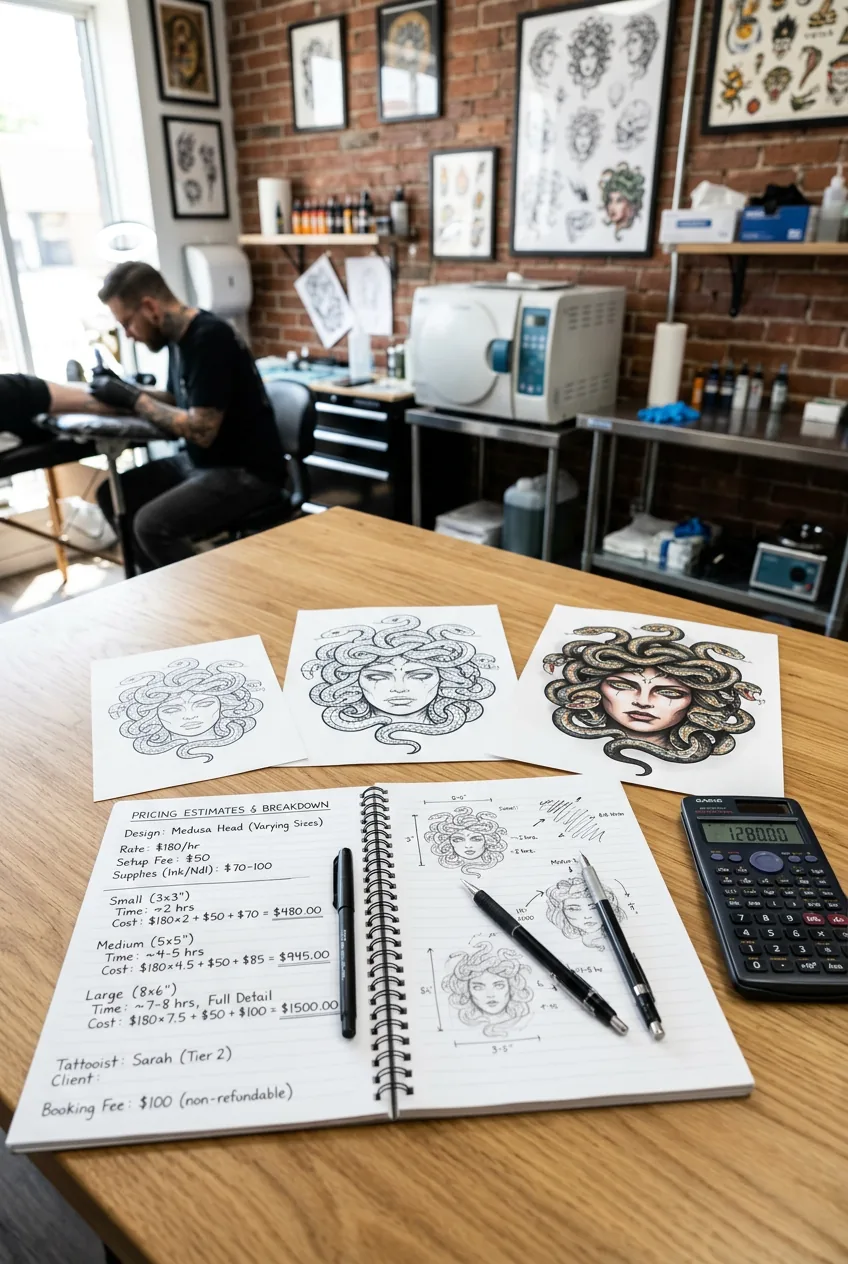
But here’s what drives up costs that clients never consider: revision requests. Medusa faces are incredibly personal. Clients often want to adjust her expression, her eye shape, the exact curve of her lips after seeing the initial design. Each revision adds $50-100 to the final cost.
Color adds another 30-50% to the price. Even subtle color — just hints of green in the snakes, a slight flush to her cheeks — requires significantly more time and skill. Full color Medusa pieces with elaborate backgrounds can take 30+ hours.
Location matters for pricing too. The exact same Medusa design costs twice as much in New York or Los Angeles compared to smaller cities. But quality varies dramatically by region, so sometimes that price difference reflects actual skill gaps.
My advice? Budget 20% more than the initial quote. Good Medusa tattoos almost always take longer than estimated because artists get caught up in perfecting the details. And trust me — you want them to take that extra time.
What Artists Really Think About Snake Details
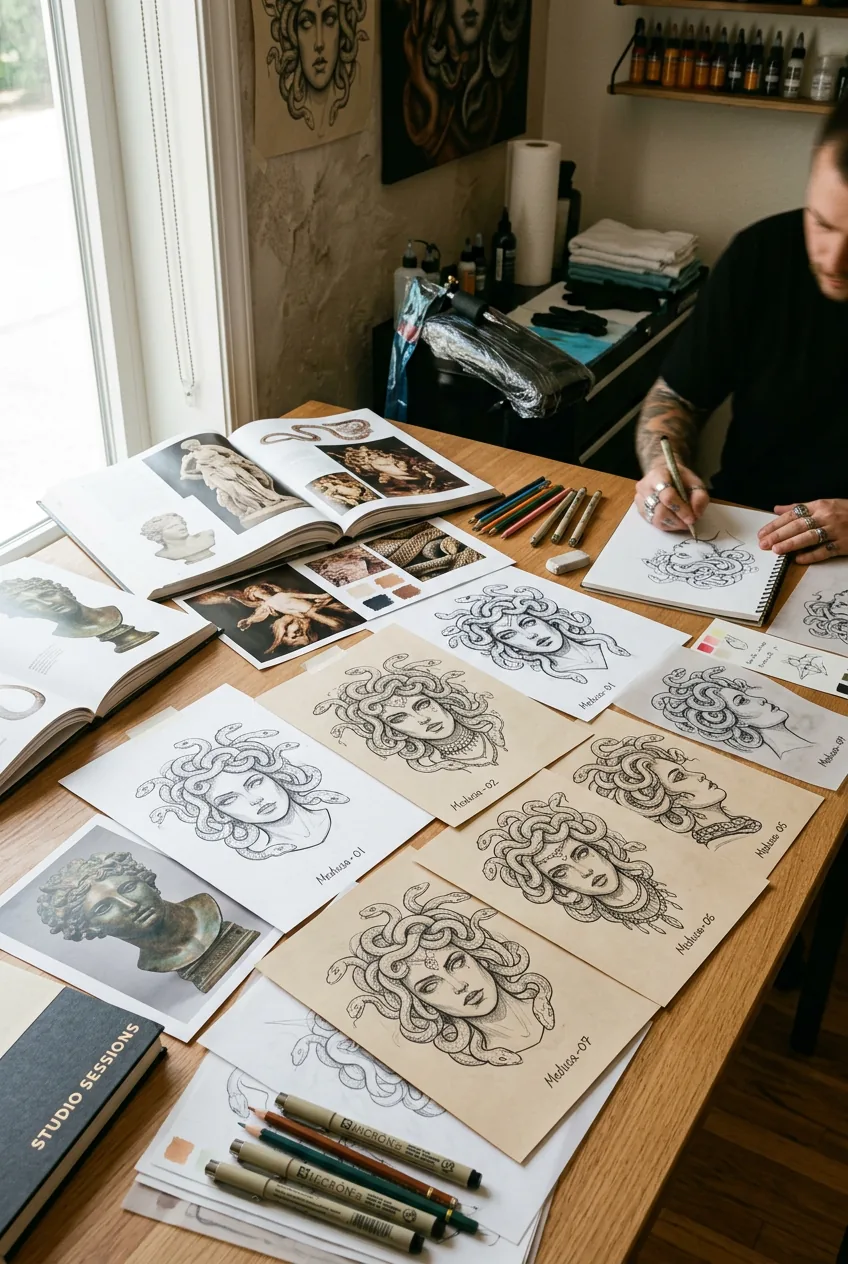
Here’s something clients never hear: most artists have strong opinions about snake execution in Medusa tattoos. After talking with a dozen different tattooers about their Medusa work, some patterns emerged that surprised me.
Every single artist mentioned the “spaghetti problem.” That’s when snakes look like random noodles instead of living creatures with purpose and anatomy. It happens when artists treat each snake as an independent design element rather than part of an integrated hair system.
The best Medusa tattoos follow hair logic. Snakes emerge from the scalp in natural hairline patterns. They follow the flow and weight that real hair would have. Some cluster together, others separate and cascade. They respond to gravity and movement just like hair would.
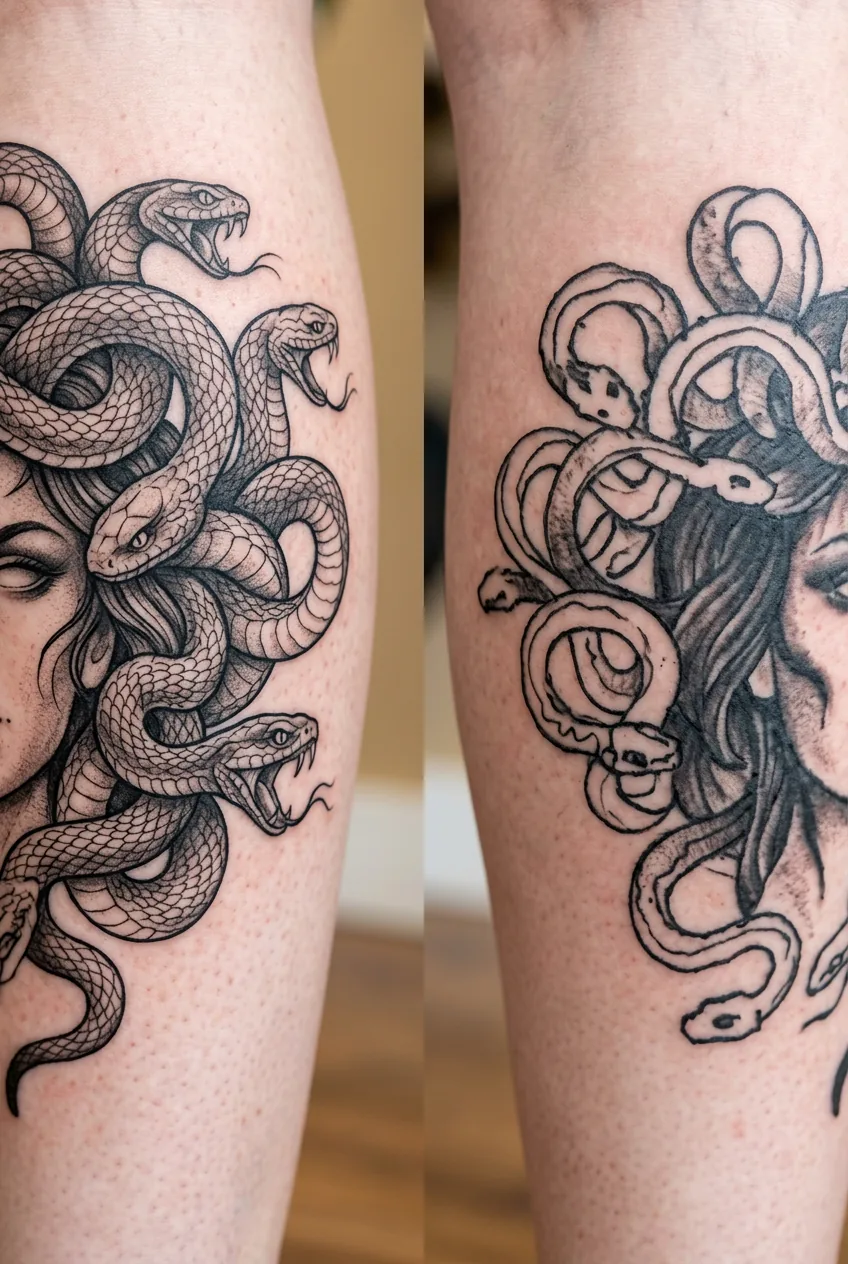
Scale detail is where artists separate themselves. Beginner artists either skip scales entirely or make them too uniform and geometric. Experienced artists vary the scale size, direction, and visibility. Scales near the head are smaller and more defined. Scales toward the snake tips become more subtle, sometimes disappearing entirely into smooth skin.
Snake design techniques vary wildly between artists, but the masters all emphasize that each snake needs a clear beginning, middle, and end. You should be able to follow any individual snake from scalp to tip without getting lost in the visual chaos.
Artists also have strong feelings about snake heads. Some prefer them all facing different directions for visual interest. Others like several snakes looking toward the viewer to increase the confrontational energy. The worst approach, according to every artist I interviewed, is having all snake heads point the same direction — it looks unnatural and static.
Here’s an insider detail: good artists plan the negative space between snakes as carefully as the snakes themselves. Those gaps create depth, allow individual snakes to stand out, and prevent the whole design from becoming a muddy tangle. When you see a Medusa tattoo that “pops,” it’s usually because the artist mastered negative space management.
The controversial opinion among artists? Many think fewer snakes work better than more snakes. Rather than cramming dozens of thin serpents into the hair area, they prefer 8-12 substantial snakes with real presence and personality. It’s harder to design but much more impactful as a finished tattoo.
Watch This Artist Explain Snake Flow
How These Age Over 10 Years
Nobody wants to hear this, but Medusa tattoos age differently than most designs. I’ve now seen enough five to ten-year-old Medusa pieces to identify the patterns. Some age beautifully. Others… don’t.
The face ages best when it’s designed with aging in mind. Strong, clear features hold up better than delicate details. Fine line work around the eyes — those subtle expression lines that look so beautiful when fresh — often blur together after five years. The result is a face that loses its emotional impact and definition.
Snake scales are the biggest aging challenge. Tiny, detailed scales look incredible for the first two years. But skin changes, ink spreads slightly, and those crisp individual scales start merging into gray patches. The solution isn’t avoiding scales — it’s designing them larger from the beginning.
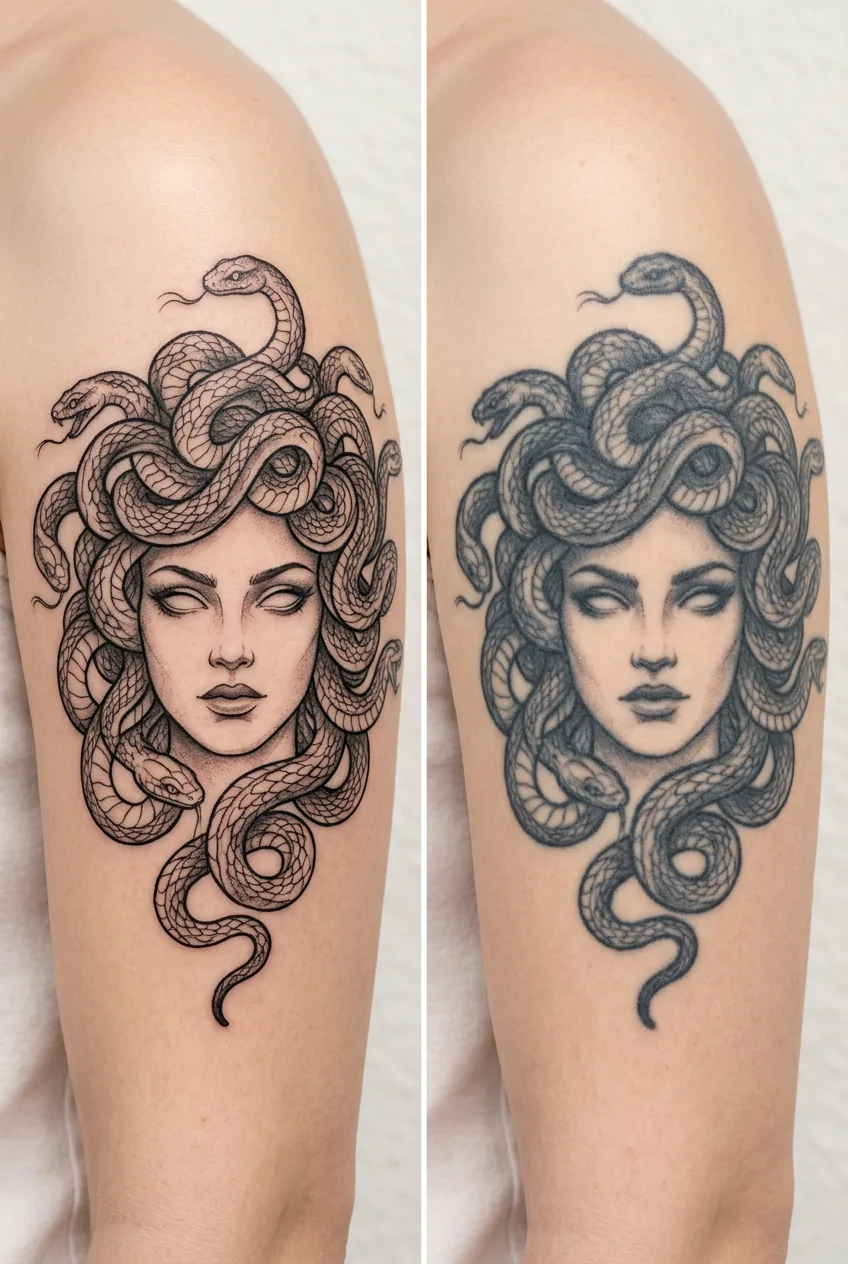
Placement dramatically affects aging. Medusa tattoos on areas with significant muscle movement (like biceps or shoulders) tend to distort over time. The snakes that looked perfectly curved when your arm was in the “tattoo position” might look stretched or compressed in natural arm positions.
Color Medusa tattoos age unpredictably. Greens in the snakes often fade to muddy browns. Subtle skin tones in her face can yellow or gray out. The artists I trust for color Medusa work always go slightly more saturated initially, knowing the colors will settle and fade to the intended intensity.
But here’s what ages beautifully: bold, well-defined snake bodies with good contrast against the skin. Simple, strong facial features that capture her essence without relying on tiny details. Solid black line work that defines the overall composition.
The ten-year mark is when you see the real difference between good and great Medusa tattoos. Great ones still look intentional, powerful, and clear. They might be softer than when fresh, but they retain their impact. Poor ones look muddy, confused, or flat.
My controversial take? Most people should go bigger and bolder with their Medusa design than they think they want. What feels “too intense” in the design phase often becomes “just right” after a few years of settling.
Who Does Medusa Tattoos Best
Not all tattoo artists should be doing Medusa tattoos. This sounds harsh, but it’s true. The combination of portrait work, fine detail, and symbolic understanding required eliminates a lot of otherwise skilled artists.
Portrait specialists often struggle with Medusa because they’re trained to capture exact likenesses. But Medusa isn’t a real person — she’s an idealized mythological figure. Artists need to create a face that feels both classical and personal, which requires a different skill set than copying a photograph.
Traditional artists sometimes nail the bold, iconic aspects of Medusa but miss the emotional subtlety. Their versions can look too cartoonish or aggressive, missing the complex feminine power that draws people to this symbol.
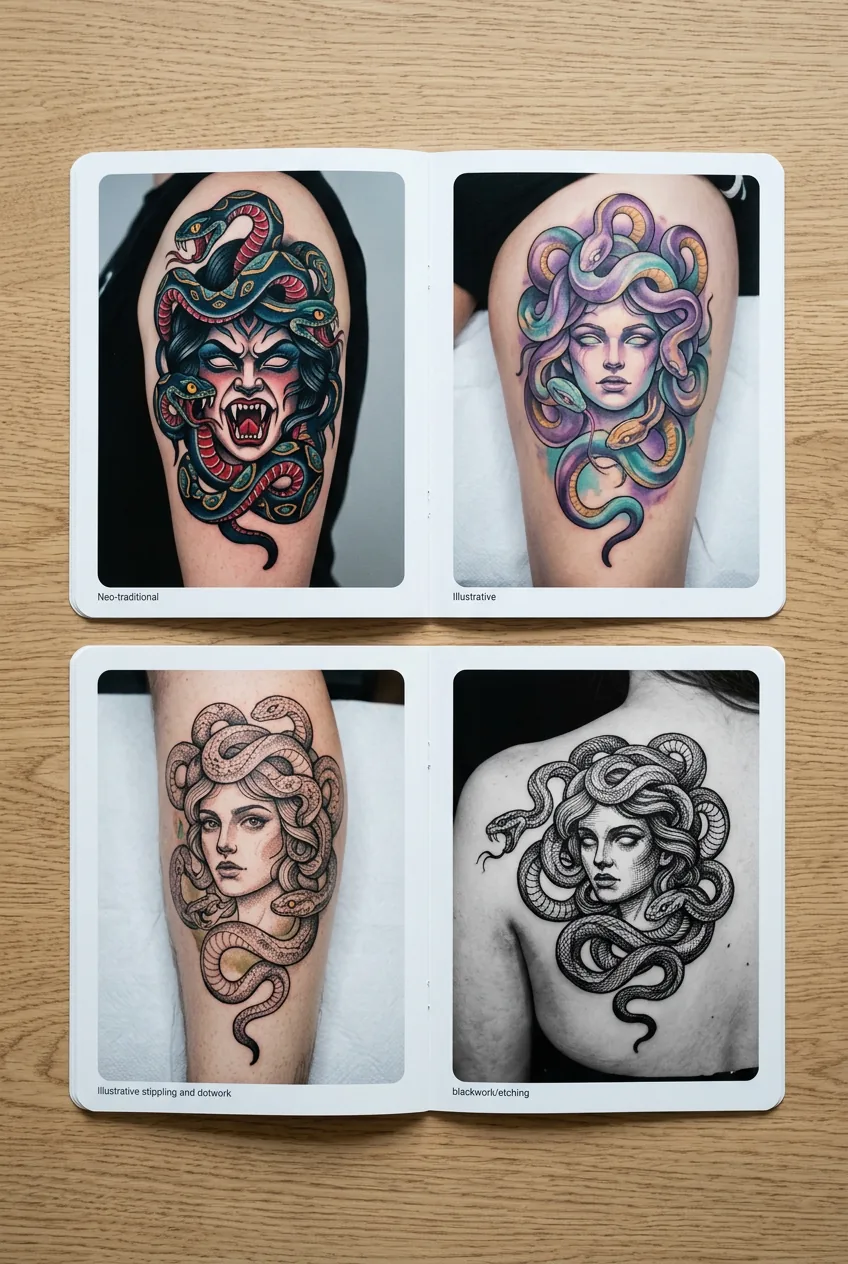
The best Medusa artists come from neo-traditional or illustrative backgrounds. They understand how to blend classical imagery with personal interpretation. They can handle both the technical demands (facial anatomy, snake textures, complex compositions) and the artistic challenges (creating emotion, building symbolic meaning, making ancient mythology feel contemporary).
Look for artists whose portfolios show range in female portraiture. They should have examples of different ethnic features, various ages, and multiple emotional expressions. If their women all look the same, their Medusa will probably be generic too.
Specialization in tattoo artistry matters more for Medusa pieces than almost any other design. Check if they’ve done multiple Medusas before — each one should look different while maintaining the artist’s consistent quality and style.
Red flags: artists who show you identical Medusa designs for different clients, artists who can’t explain why they made specific design choices, or artists who seem more excited about the snakes than the face. The face is what makes or breaks a Medusa tattoo.
Interview potential artists about their interpretation of Medusa symbolism. You don’t need them to be mythology scholars, but they should understand why this image resonates with people. If they see it as just “pretty girl with snake hair,” find someone else.
The investment in finding the right artist pays off exponentially. A great Medusa tattoo becomes more meaningful over time. A mediocre one becomes a source of regret. Given how much these pieces cost and how prominently they’re usually placed, settling for “good enough” isn’t worth it.
Quick Answers About Medusa Tattoos
Do Medusa tattoos have to be large?
Not necessarily, but smaller Medusa tattoos lose a lot of impact. The detail work that makes these designs compelling requires space. I’d say 4-5 inches minimum to capture her properly.
Can men get Medusa tattoos?
Absolutely. While women choose Medusa for empowerment symbolism, men often connect with the protection and transformation aspects. The design approach might differ slightly, but the core power remains.
How long does a detailed Medusa tattoo take?
Plan for 8-15 hours minimum for a quality medium-sized piece. Large, detailed Medusas can take 20-30 hours across multiple sessions. The face alone often requires 3-4 hours of careful work.
What’s the most painful placement for a Medusa tattoo?
Ribcage and sternum are notoriously painful, especially for the detailed work Medusa requires. Forearm and shoulder blade are much more manageable for long sessions.
Should I get color or black and gray?
Black and gray ages better and costs less, but subtle color can add incredible depth. If you choose color, go with an artist who specializes in it — poor color work on Medusa looks worse than no color at all.
Every Medusa tattoo tells a different story, but they all share that sense of ancient power made modern. Whether you’re drawn to the mythology, the artistry, or the symbolism, make sure your artist understands what yours means to you. That’s what transforms ink into meaning.