





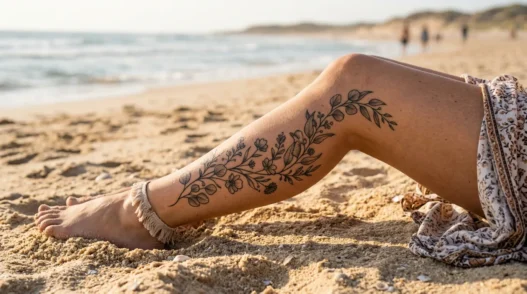
I’ve been thinking about calf tattoos a lot lately — specifically why some of them look absolutely perfect and others, even with stunning artwork, just feel off. Nine times out of ten it comes down to one thing: the design wasn’t matched to the right spot. Not the right leg, not the right angle, not the right surface. Just slightly misplaced, and it throws the whole thing.
This isn’t a guide about body type or size. It’s purely about design logic — proportions, line weight, movement, and how a specific piece of art interacts with the anatomy beneath it. Whether you’ve already got your design picked out or you’re still circling your options, this should help you figure out exactly where it goes.
What’s Covered: Design-to-Placement Matches
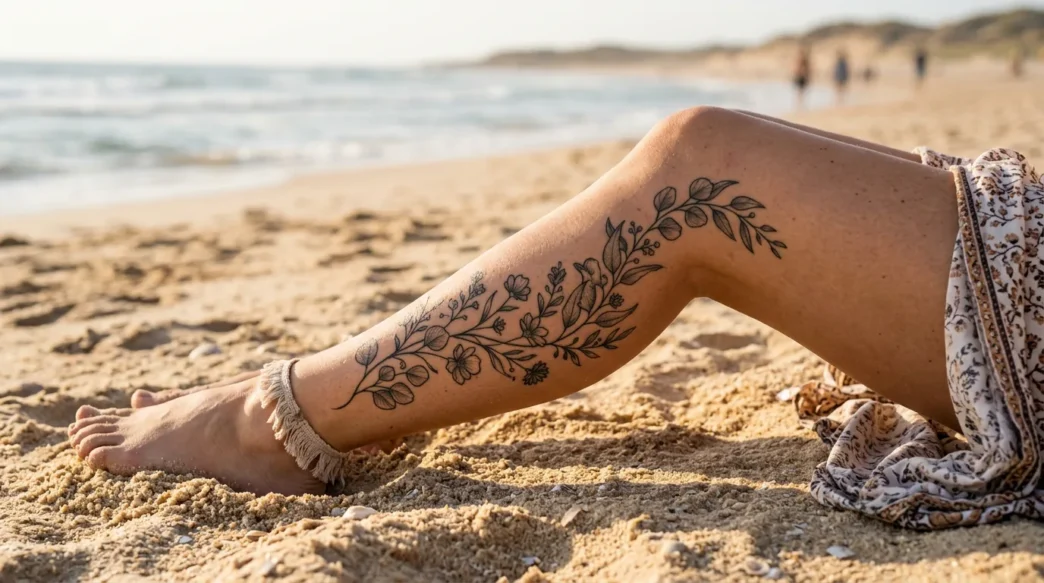
- A Long Botanical Stem — Made for the Outer Calf
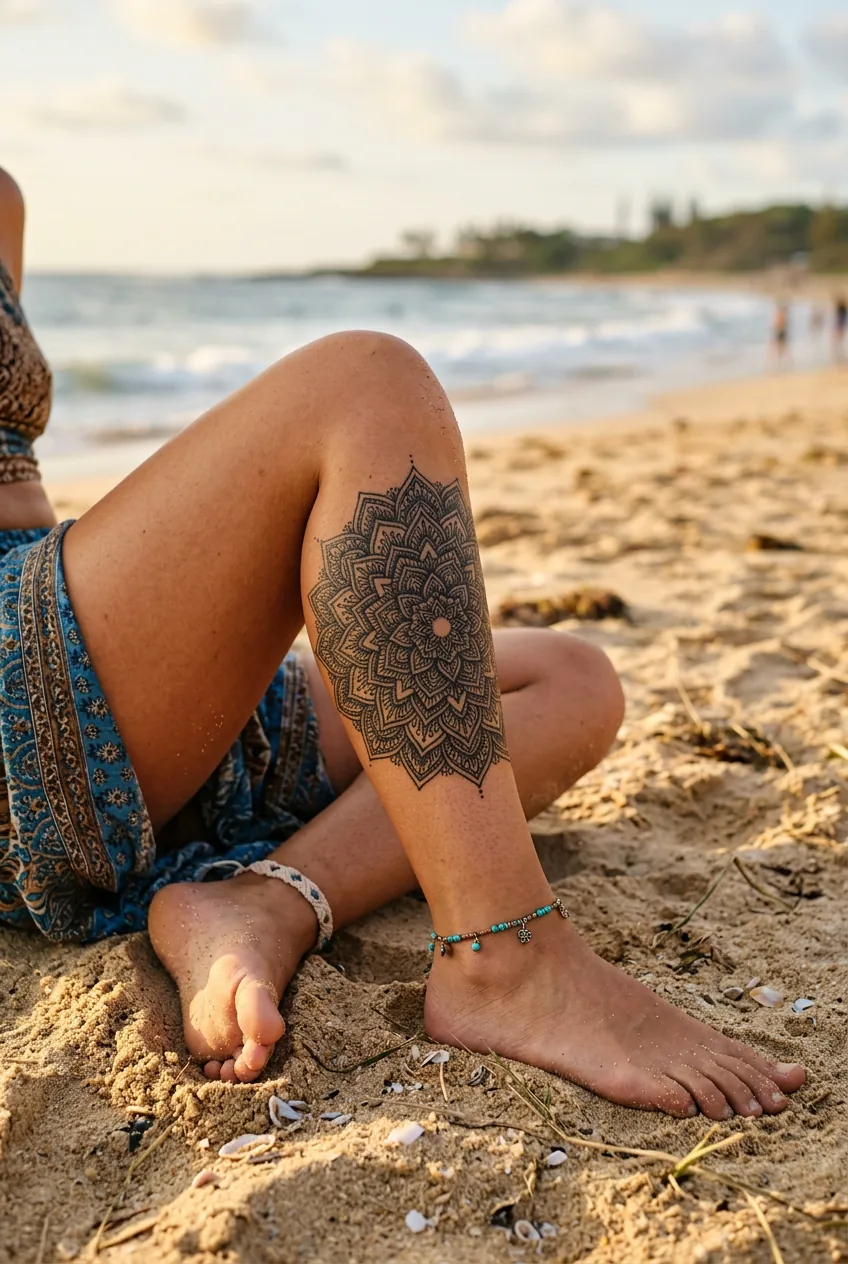
- A Dense Mandala — Built for the Center Calf
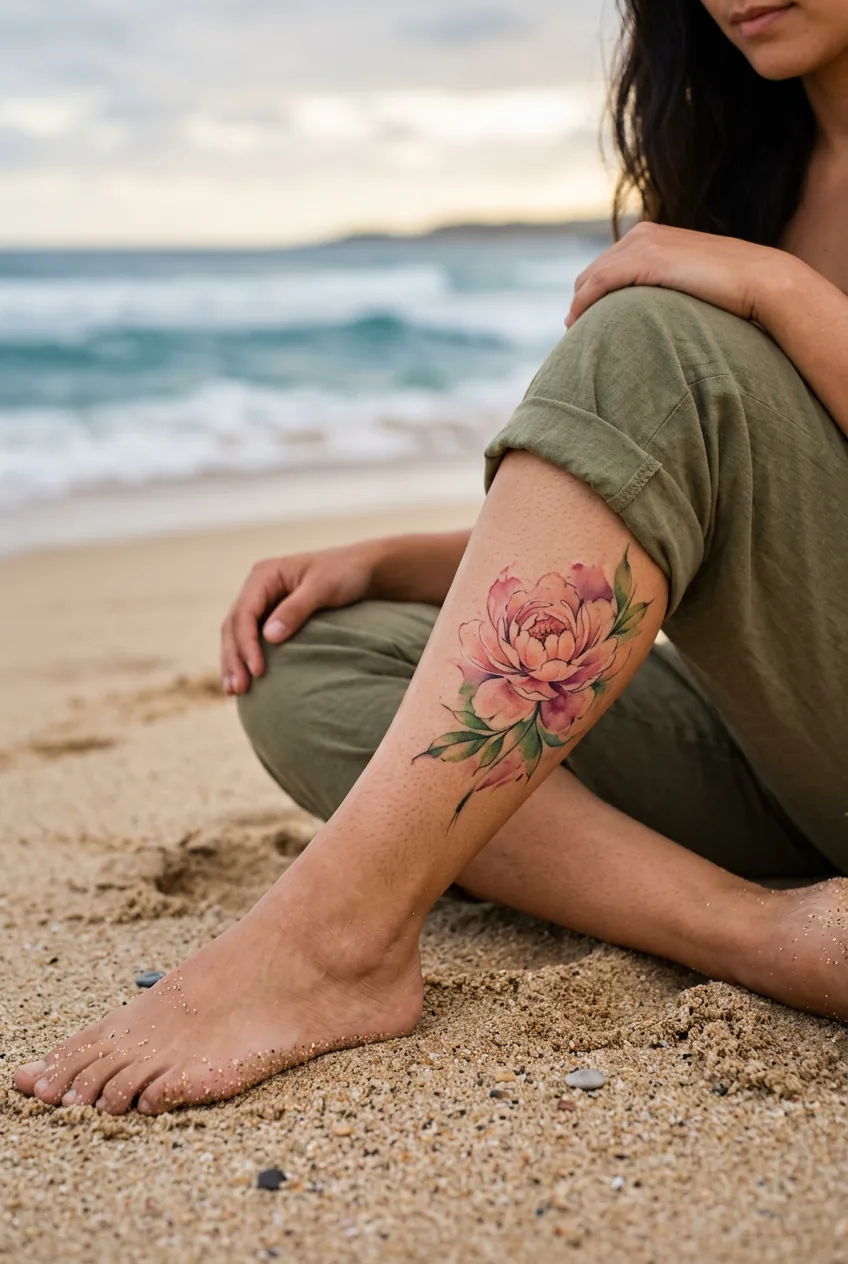
- A Loose Watercolor Bloom — Belongs on the Inner Calf
- A Serpent or Eel Shape — Wraps the Calf Beautifully
- A Single Oversized Moth or Butterfly — Owns the Back of the Calf
- A Fine-Line Portrait — Needs the Flat Inner Calf Canvas
- A Tight Geometric Motif — Built for the Outer Lower Calf
- A Script Quote — Follows the Shin Line
- A Bold Traditional Flash Piece — Front and Center on the Calf
- A Delicate Constellation or Star Map — Wraps the Ankle-to-Calf Transition
1. A Long Botanical Stem — Made for the Outer Calf
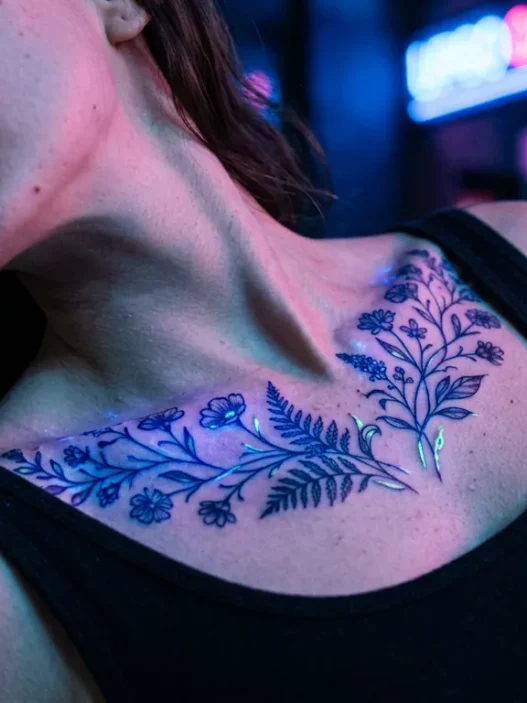
Think trailing eucalyptus, a single poppy on a winding stem, or a long branch with scattered leaves. These designs share one quality: they’re tall and narrow, with a natural directional flow. The outer calf is almost tailor-made for them.
The outer calf has a gentle, consistent curve — enough to give the piece dimension but not so dramatic that it distorts the linework. A tall botanical design can run from just above the ankle to mid-calf and still read as one cohesive piece, not something crammed in or stretched. The verticality of the stem echoes the vertical line of the leg itself, which makes the whole thing feel intentional.
Avoid placing this on the shin. The shin is bonier, flatter, and honestly more painful — and it tends to flatten a design that needs a little curve to breathe. The back of the calf is also risky for fine botanical linework because the rounded muscle can make thin stems look warped when the leg is in motion.

2. A Dense Mandala — Built for the Center Calf
Mandalas are symmetrical, radial, and — when done well — breathtaking. They’re also deeply unforgiving of bad placement. A mandala needs a relatively flat, wide surface to read correctly, and the center of the calf (roughly where the gastrocnemius muscle peaks) gives you that.
Sitting at the broadest part of the calf, a mandala can expand to fill the space without the outer edges getting swallowed by the curve of the leg. The symmetry stays intact. The geometric detail — all those dots and interlocking shapes — stays legible. It’s also a placement you can actually see in a mirror, which matters when you’ve spent months planning the design.
Don’t try to force a large mandala onto the inner calf. The surface there tapers and curves toward the back, and you’ll watch your perfectly balanced design appear to lean or compress depending on the viewing angle. Ask your artist how fine lines age before committing to a highly detailed mandala in any placement — density matters a lot for longevity.
3. A Loose Watercolor Bloom — Belongs on the Inner Calf
Watercolor tattoos — soft washes of color, ink that seems to bleed outward, no hard black outlines — have a deliberately uncontained quality. That looseness is exactly why the inner calf works so well for them.
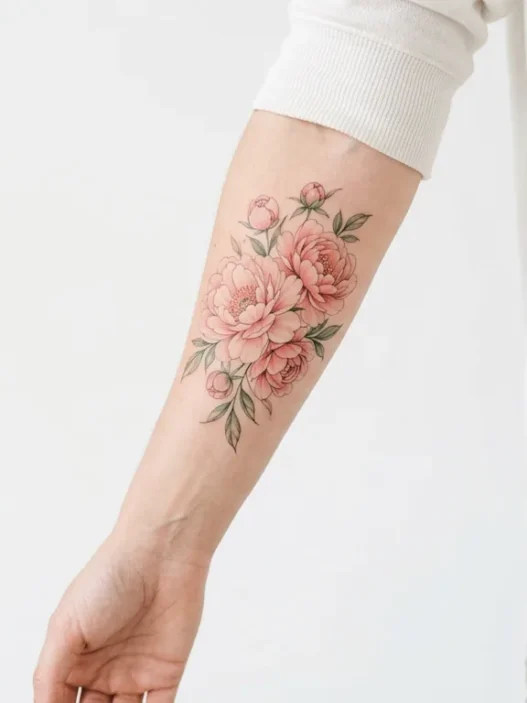
The inner calf is a slightly softer, more intimate placement. It’s not always on display. You catch glimpses of it when you cross your legs, or when someone’s sitting with their foot tucked up. That quality matches the softness of the watercolor style — both feel like something you discover rather than something announced. A big peony or a loose wildflower cluster in watercolor on the inner calf has this almost accidental beauty to it.
The one placement to avoid? The shin. Watercolor bleeds and softens over time, and the bony, flatter surface of the shin doesn’t give it anywhere to bloom. On the inner calf, the slight roundness actually helps diffuse those ink edges in a way that looks intentional as the tattoo ages.
4. A Serpent or Eel Shape — Wraps the Calf Beautifully
Long, sinuous, body-following designs — serpents, eels, koi fish in a vertical orientation, long dragons — are almost engineered for the calf. I’m obsessed with how these look when they’re done right. The design mimics the movement of the leg itself.
A serpent that starts near the ankle and winds its way up the back of the calf, curling slightly around the side? That’s a piece that uses the body as part of the composition. The curve of the muscle becomes the curve of the serpent’s body. You’re not fighting the anatomy — you’re collaborating with it. This is one of those placements where the tattoo genuinely looks better on a body than it ever would on flat paper.
This is my personal pick for the most underrated calf tattoo design type. Every time I see a well-placed serpent wrap around someone’s calf, I have to stop and stare. There’s something about the way it moves with the body — it’s not static, it’s alive. If you’re on the fence about a serpent design, this is the placement that sells it.
Avoid placing a long serpent on the front shin going straight down. It flattens the design completely, turns a dynamic piece into something that looks like a sticker, and loses all the sinuous quality that makes serpents so compelling. You can read more about how designs like these behave across different placements in this spine, forearm, or calf placement guide — genuinely useful if you’re comparing options.
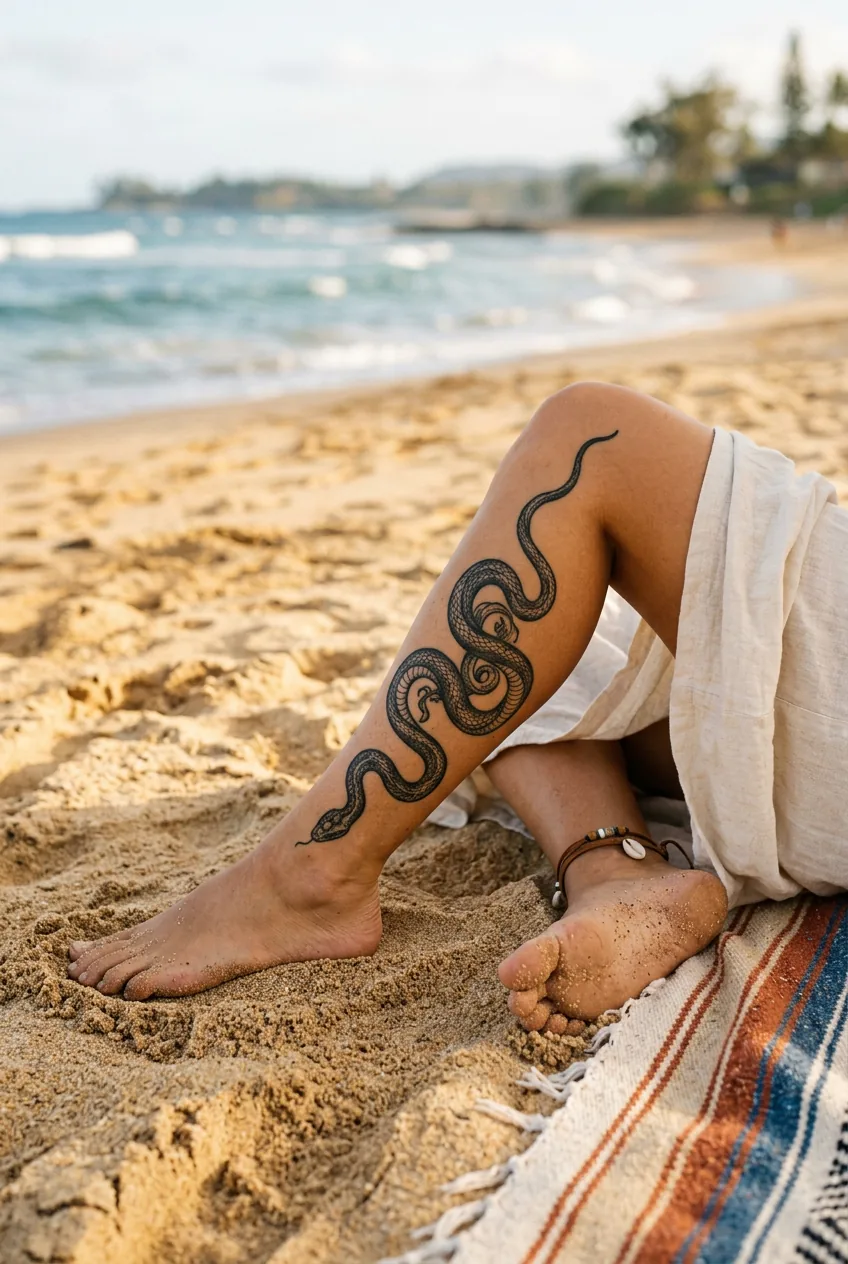
A Wrap Design That Changes How You See the Calf
5. A Single Oversized Moth or Butterfly — Owns the Back of the Calf
Wings are wide. The back of the calf is wide. This is honestly just math.
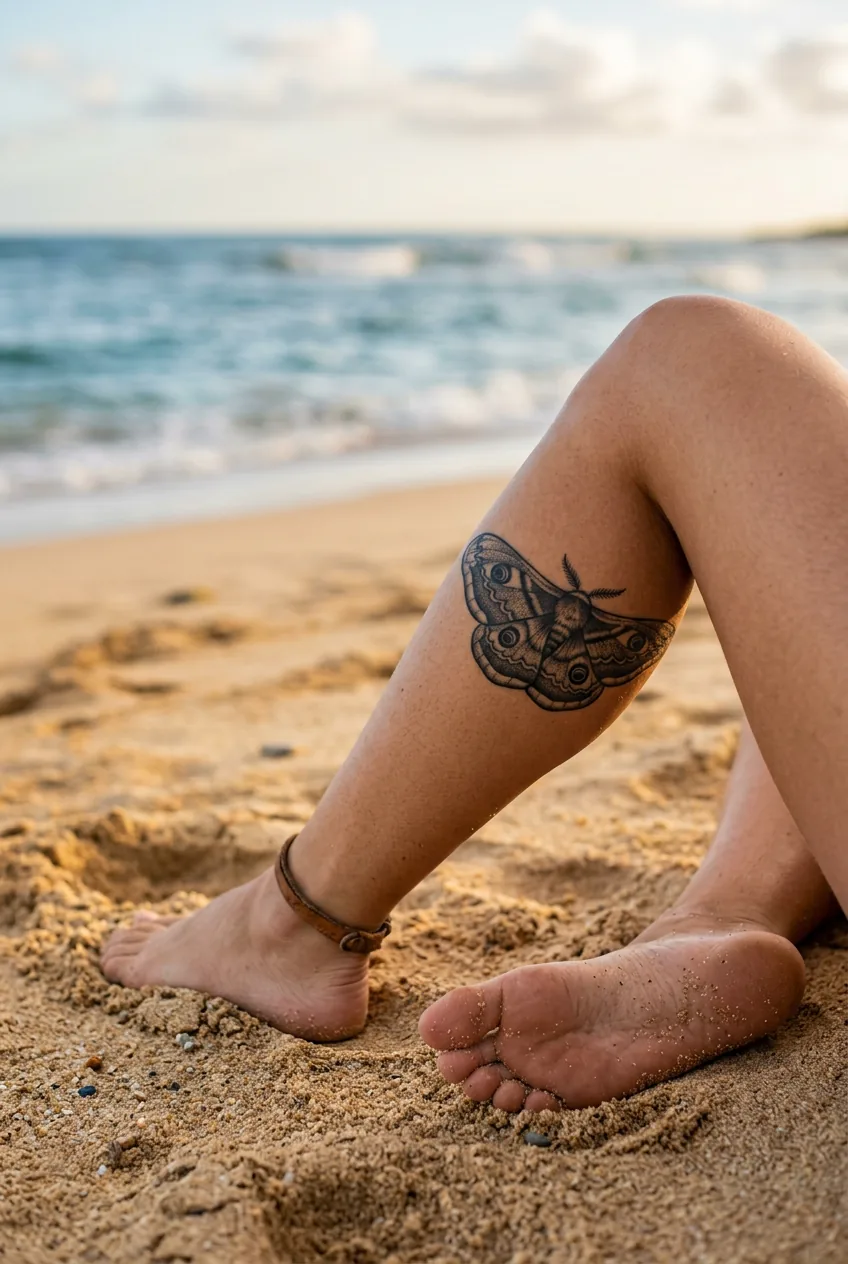
A large moth or butterfly design with fully spread wings needs a surface that can accommodate horizontal span without the wings wrapping awkwardly around a curve. The back of the calf — that broad, slightly rounded expanse — is perfect. The wings can stretch outward, and the natural roundness of the calf gives them a subtle three-dimensional quality, like the moth is actually perched there.
Look at the photo below — she’s got a large moth centered on the back of her calf, and the symmetry is immaculate. Both wings read evenly. The detail in the wingspan stays crisp. That’s the ideal result when the design width matches the surface width.
Avoid placing a wide-wing design on the outer or inner calf where the surface curves sharply. The wings will appear uneven — one larger, one smaller — depending on the viewing angle, and symmetrical designs are especially sensitive to that distortion. If you’re drawn to animal tattoos like moths and butterflies, placement really is everything for making the symmetry land.
6. A Fine-Line Portrait — Needs the Flat Inner Calf Canvas
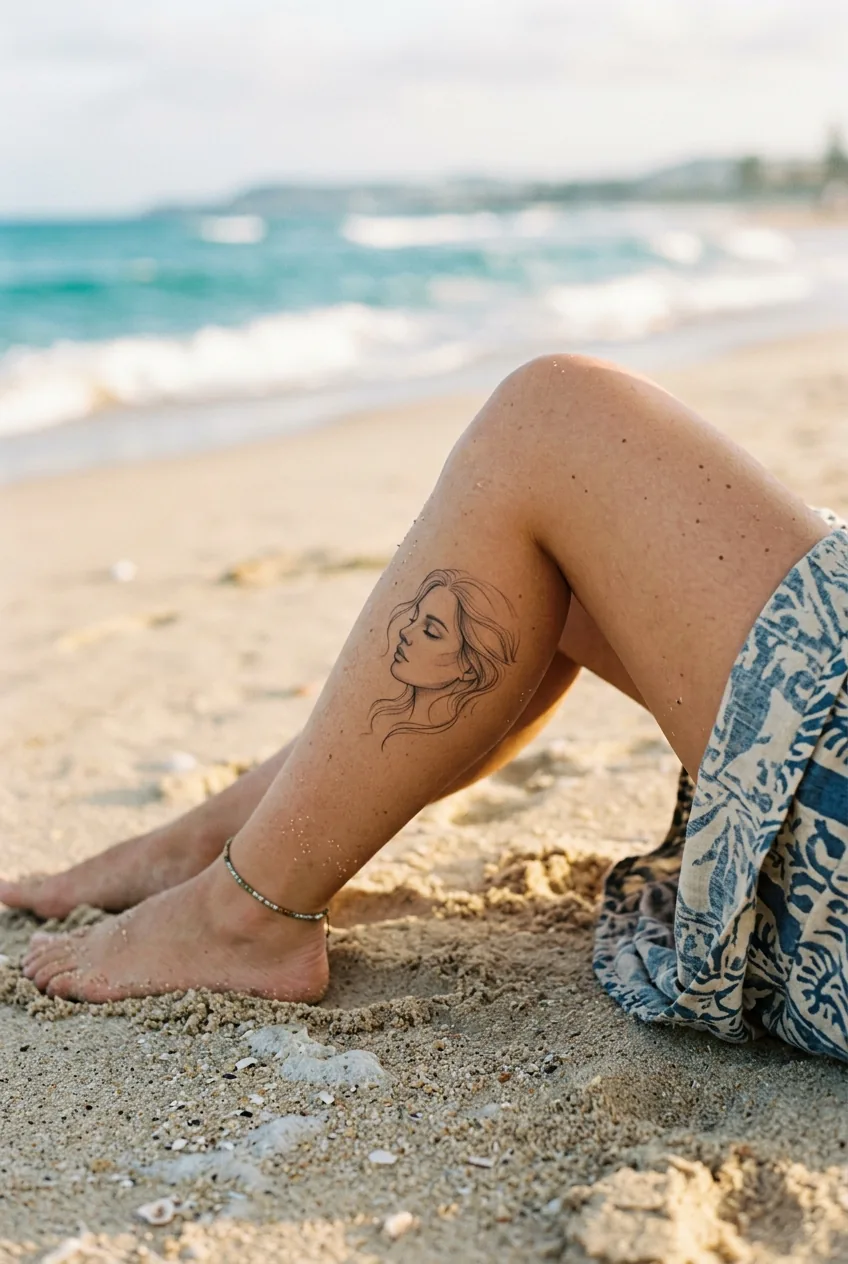
Fine-line portraits are technically demanding in a way that most other tattoo styles aren’t. The detail is everything — the shading in an eye, the curve of a lip, the softness of a jawline. Any surface distortion and you lose those details.
The inner calf, especially in its upper section just below the knee, offers one of the flatter, more stable surfaces on the lower leg. It’s not perfectly flat, but compared to the rounded back or the angled outer calf, it gives a fine-line artist the closest thing to a canvas. Portraits placed here tend to age better too, because they’re not constantly folding over a peak of muscle.
Avoid the back of the calf for fine-line portrait work. The muscle bulges outward significantly, which means as you view the tattoo from straight behind, the edges of the face can appear to curve away from you. It’s subtle but it matters for something as detail-reliant as a portrait.
7. A Tight Geometric Motif — Built for the Outer Lower Calf
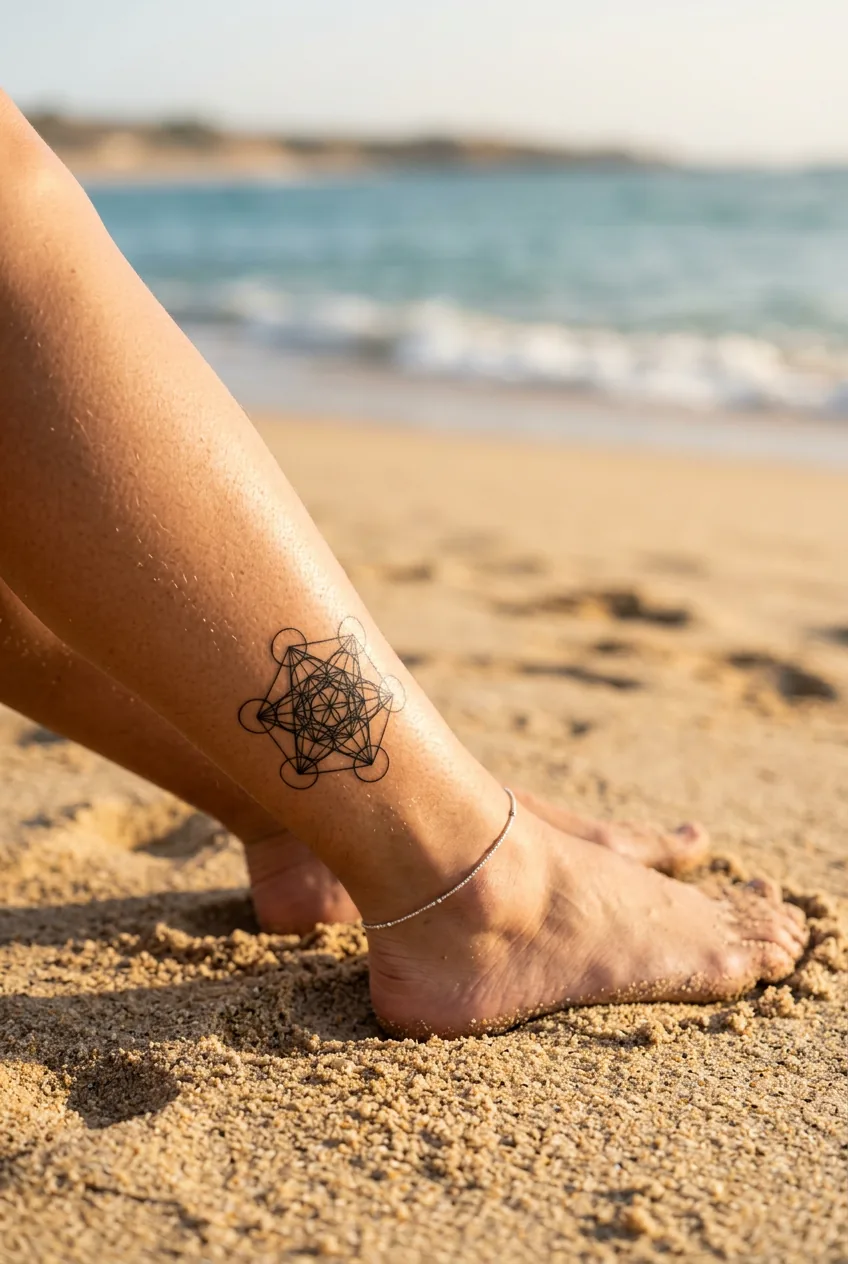
Sacred geometry, precise linework triangles, small hexagonal patterns — these are compact, angular, and usually not very tall. They need a placement that frames them without swallowing them, and the outer lower calf (the area just above the ankle bone, below the main muscle belly) does exactly that.
This spot has a natural visual focus — it’s prominent when wearing shorts, visible above a sneaker or sandal, and the slight bony structure of the lower outer leg actually gives geometric designs a harder, more architectural backdrop that suits the style. A tight geometric motif here looks intentional and considered. Almost architectural.
Don’t place small geometric pieces in the middle of the calf where the muscle dominates. They’ll get visually lost in the larger surface. Geometric precision also suffers on highly curved surfaces — if the angles are meant to be sharp, they need a relatively stable plane. If you’re exploring leg tattoos broadly, this lower outer calf sweet spot is one I keep coming back to for smaller geometric designs.
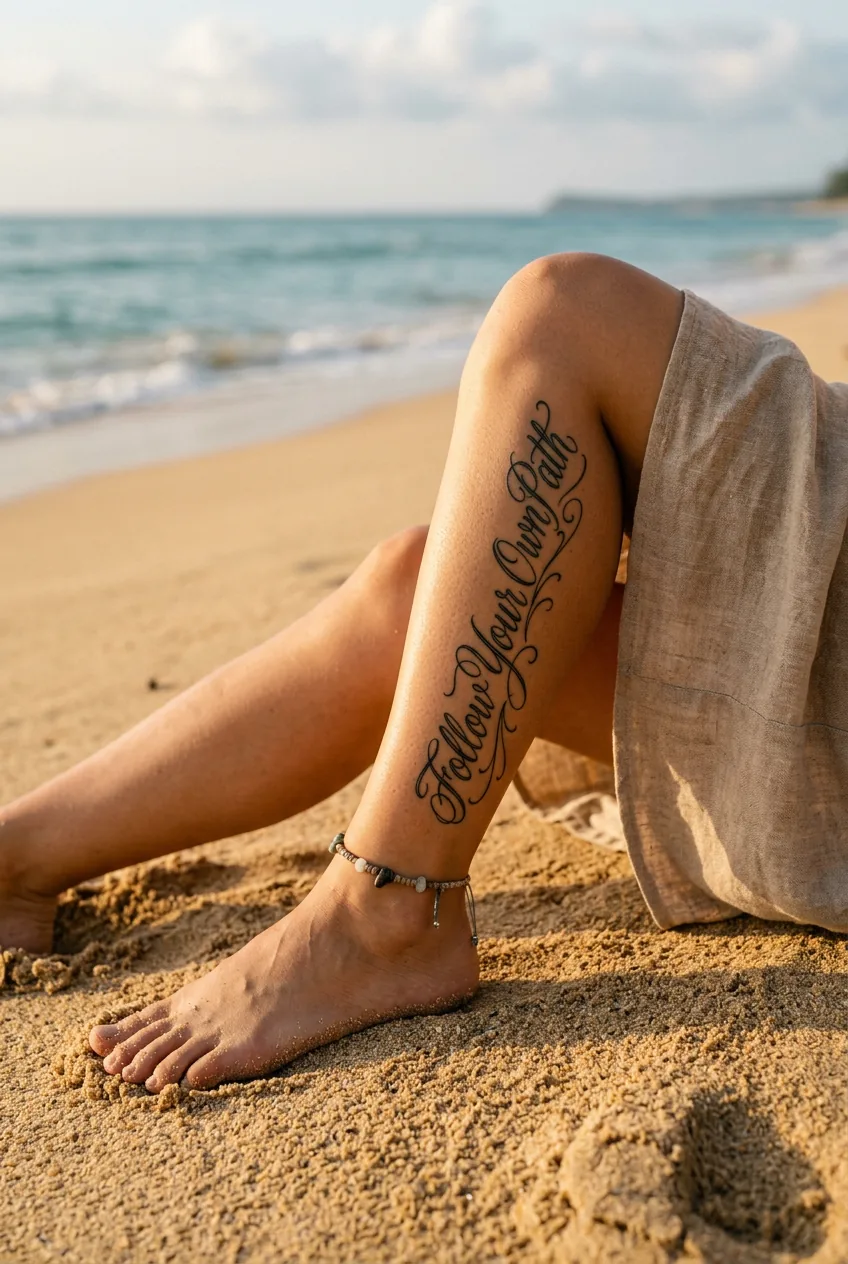
8. A Script Quote — Follows the Shin Line
Script tattoos are directional by nature — they travel horizontally or at a slight diagonal, and they need a surface that doesn’t curve too aggressively beneath them or the letters start to look uneven.
The shin line — running vertically down the front of the lower leg — is actually a surprisingly good spot for a short-to-medium script quote. A single line of text running down the shin reads like a column of words, which can look incredibly elegant. Alternatively, a short phrase placed horizontally just below the knee on the front of the leg has enough flat surface to stay legible and level.
Where script goes wrong on the leg is the back of the calf. The curve there is dramatic enough that a horizontal phrase will appear to bow upward in the middle, which distorts the letterforms. Always ask your artist to do a stencil check from multiple angles before committing script to any curved surface. Script lettering styles vary in how they hold up to curves — some fare better than others.
9. A Bold Traditional Flash Piece — Front and Center on the Calf
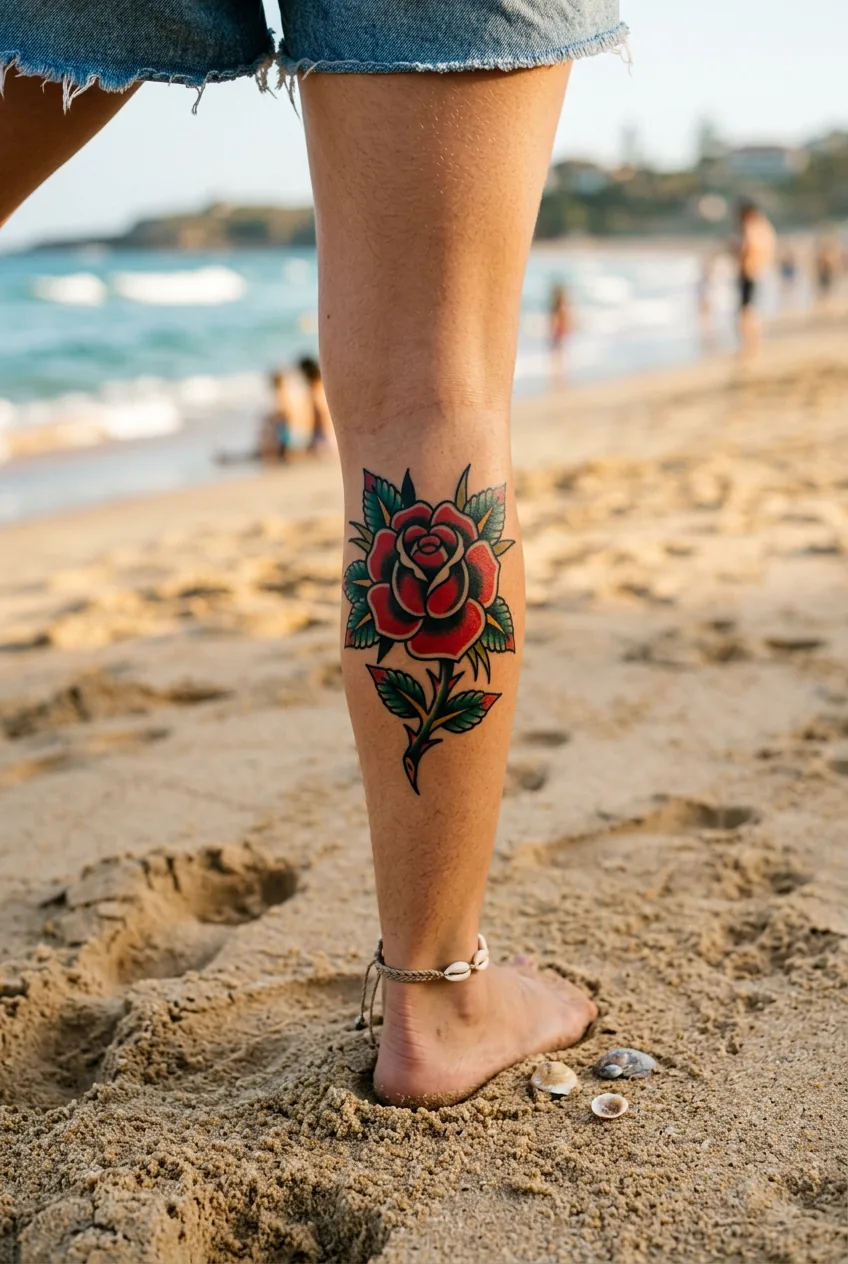
Traditional tattoos — thick black outlines, saturated primary colors, classic motifs like roses, daggers, panthers, swallows — are built to be seen. They’re bold, graphic, and unapologetically present. And they belong front and center on the calf, facing outward.
The front-facing calf (the shin-adjacent area, slightly rotated outward) is the display window of the lower leg. It’s what people see when you’re sitting across from them, when you cross your legs at a table, when you walk toward someone. A traditional flash piece here reads exactly as it’s meant to — as a clear, confident graphic statement. The thick outlines hold up beautifully over the years on this placement because it doesn’t experience the kind of constant flexion that other spots do.
Avoid the inner calf for bold traditional work. The inner calf is a subtler, more private placement, and traditional flash tends to look out of context there — like it’s hiding. These designs thrive on visibility. There’s a great breakdown of how different design weights behave across placements in this honest look at leg tattoos women actually want — worth a read before you decide.
10. A Delicate Constellation or Star Map — Wraps the Ankle-to-Calf Transition
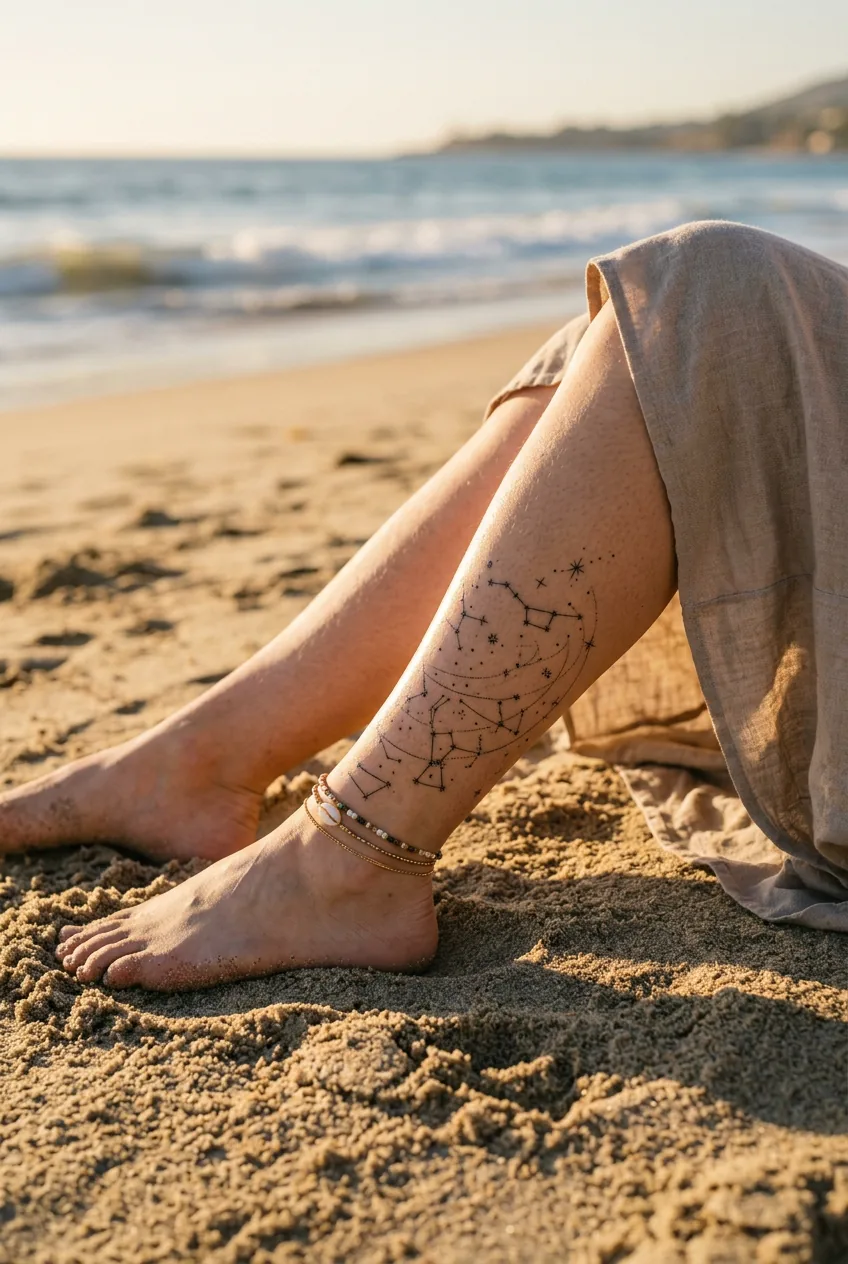
Constellations and star maps are made up of dots and fine connecting lines — minimalist, scattered, and intentionally airy. They don’t need a large flat surface. In fact, they look better when they’re allowed to wrap and scatter across a transitional zone.
The ankle-to-calf transition — that area where the ankle narrows and then the calf begins to swell — is perfect for a wrapping constellation. The design can start near the ankle bone, arc upward, and scatter across the lower calf in a way that feels genuinely cosmic, like the stars are just doing their own thing. The varying surfaces actually enhance the scattered effect rather than undermining it.
This is one of the few design types where I’d say don’t pick a single flat surface — let it move. Avoid confining a star map to just the back of the calf, where it’ll look like a flat sticker rather than something that wraps around your leg. If you’re also considering how this might connect to an ankle piece or a foot design, check out the broader category of leg tattoos for ideas on how pieces can flow between zones. And if you want to see how similar wrapping designs work on the arm, wrapping tattoo designs show up beautifully on arm tattoos too.
Questions I Get About This
Does the calf muscle size affect which designs work there?
Muscle size affects how much surface area you’re working with, but the design-to-placement logic stays the same. A larger calf gives you more room to scale up a design — a mandala can go bigger, a portrait has more canvas. What doesn’t change is that curved surfaces still distort symmetrical or text-based designs, regardless of size.
Is the calf more or less painful than other leg placements?
Most people find the calf pretty manageable — it’s fleshy and not close to bone, which helps. The shin, ditch behind the knee, and areas close to the ankle bone tend to be more intense. Pain is individual, but the calf is generally considered one of the more tolerable spots on the lower body.
Can a calf tattoo be combined with an ankle or knee design?
Absolutely — and when it’s done well, it looks incredible. The key is planning the full composition from the start rather than adding pieces separately over time and hoping they connect. Talk to your artist about how the scale and style of each piece will relate to the others before any ink goes down.
How long does a calf tattoo take to heal compared to other spots?
Calf tattoos typically follow a standard healing timeline — surface healing in 2–3 weeks, full deep healing in 3–6 months. Because the calf moves a lot (every step you take), keeping it moisturized during the first couple of weeks is especially important. Tight leggings or socks can also rub during healing, so loose clothing is your friend.
Honestly, the more I think about tattoo placement, the more I’m convinced that a good design in the wrong spot is a missed opportunity — and a decent design in the right spot can look extraordinary. The calf is one of the most versatile real estate options on the body, but it’s not one-size-fits-all. Match the movement of your design to the movement of the surface, respect the curves, and you’ll end up with something that looks like it was always supposed to be exactly there.