



I’ve been tattooing for over a decade, and tribal work sits in a very particular corner of my heart — the complicated one. It’s one of the oldest forms of body art on earth, steeped in lineage and meaning, and it’s also one of the most frequently butchered styles I see walk through studio doors. So I wanted to write something honest. Not a Pinterest board. An actual breakdown of what holds up, what needs a serious conversation first, and what I straight-up recommend skipping.
These are my real picks — the ones I get excited about taking on, the ones I give caveats to, and yes, the ones I quietly try to redirect. Trust is built on honesty, so here we go.
Your Guide Through This Post
- 1. Worth Every Session: Polynesian Spine Column
- 2. Worth Every Session: Māori-Inspired Koru Shoulder
- 3. Worth Every Session: Filipino Batok Forearm Band
- 4. Great Idea, Tricky Execution: Full Blackwork Geometric Sleeve
- 5. Great Idea, Tricky Execution: Borneo-Inspired Throat Piece
- 6. The Sleeper Hit: Aztec Sun Sternum
- 7. The Sleeper Hit: Hawaiian Honu Back Panel
- 8. Worth Every Session: Samoan Pe’a-Inspired Thigh Wrap
- 9. Honestly, Skip This: Generic ‘Tribal Armband’ Flash
- 10. Honestly, Skip This: Copy-Paste Pinterest Tribal Hibiscus
1. Worth Every Session: Polynesian Spine Column
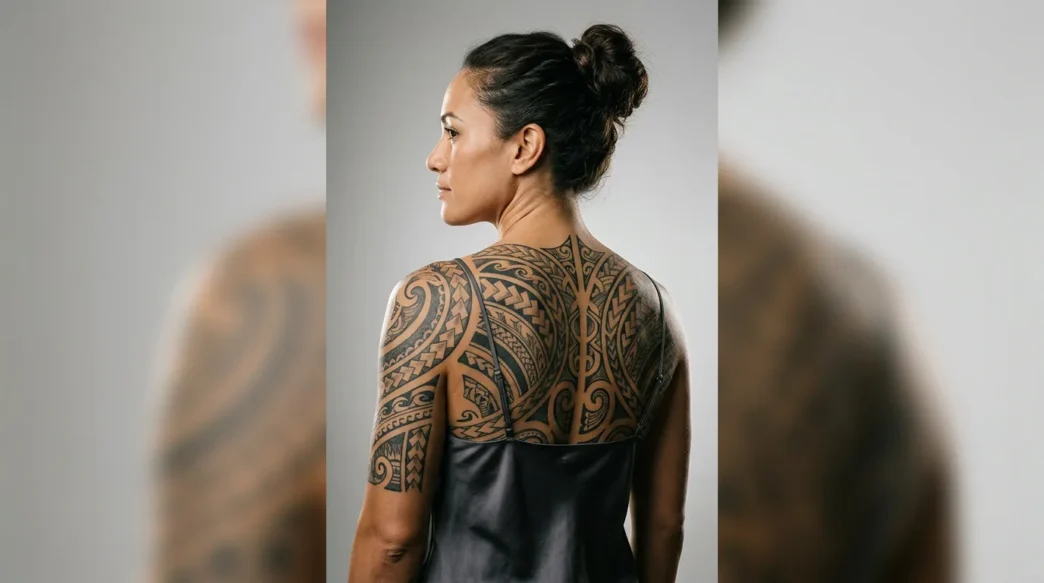
This one consistently makes me set down my coffee and actually lean in during consultations. A Polynesian-inspired column running the length of the spine — using traditional motifs like enata (human figures), ocean waves, and shark teeth — is one of those rare pieces that looks more intentional the more you look at it. The spine is a natural axis. The bilateral symmetry that defines a lot of Polynesian tatau work maps perfectly onto it.
What I tell clients who ask for this: Research the source culture. Polynesian tattooing carries deep ancestral weight, and working with an artist who respects that history — not just copies the shapes — makes all the difference. I always recommend clients read up on the cultural roots of Polynesian tatau before their consult, because a well-informed client gets a better tattoo. Full stop.
What we change about the brief: Most people come in wanting something perfectly symmetrical. We usually push for slight asymmetry that follows the natural contour of the spine — it reads more organic, less clip-art.
2. Worth Every Session: Māori-Inspired Koru Shoulder
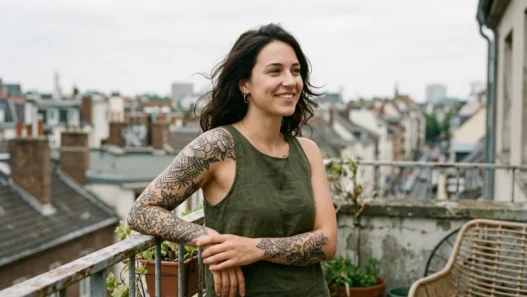
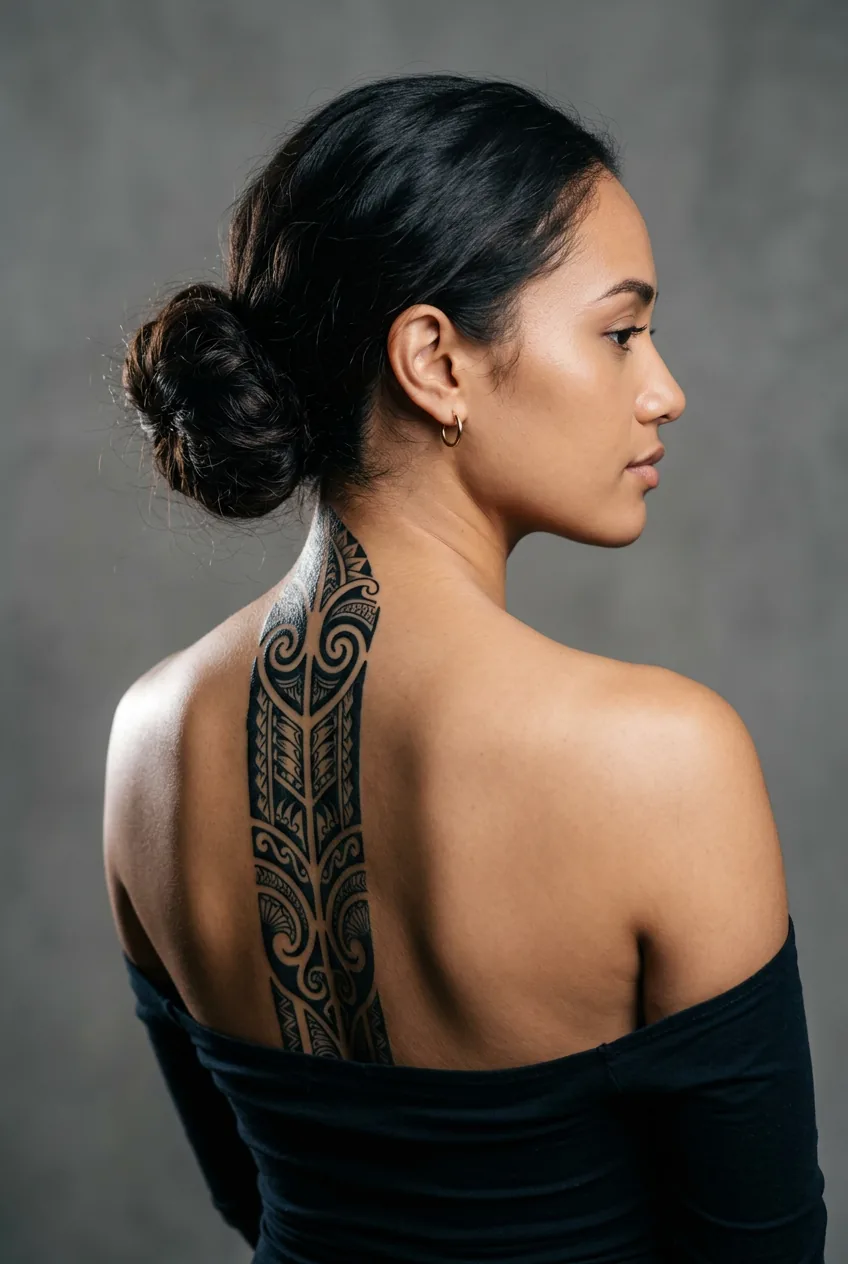
The koru — that unfurling fern frond shape at the heart of Māori visual language — is one of the most elegant single motifs you can bring into a shoulder or upper arm piece. It represents new beginnings, growth, and harmony, and visually it wraps around curved anatomy like it was designed for it. Which, honestly, it was — tā moko was never meant to exist on a flat page.
What I tell clients: Don’t just use a koru as decoration. Come in knowing what it means to you. Clients who arrive with a personal connection to the symbolism end up with a piece they’re still obsessed with five years later. Those who just thought it looked cool online often want something added or changed within eighteen months.
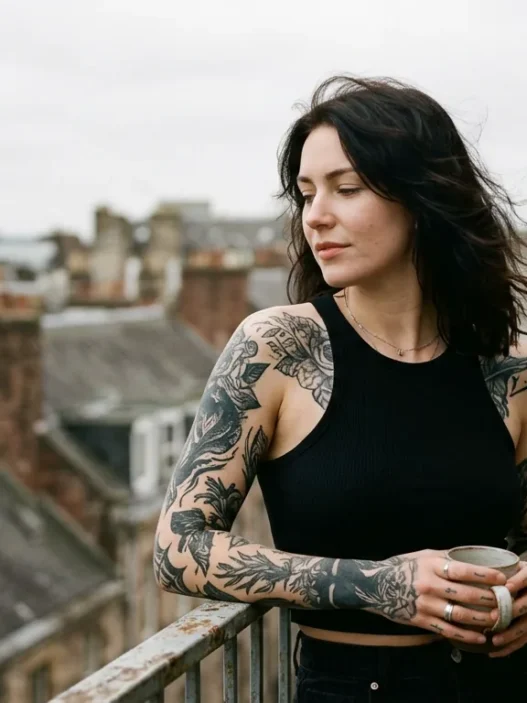
What we change about the brief: People consistently underestimate the scale needed. A koru the size of a golf ball looks like a decorative sticker. We size up — usually significantly — and the piece transforms entirely. See how she’s wearing hers in the photo below, with the design filling the shoulder cap and spilling just past the deltoid? That’s exactly what I mean about committing to the scale.
3. Worth Every Session: Filipino Batok Forearm Band
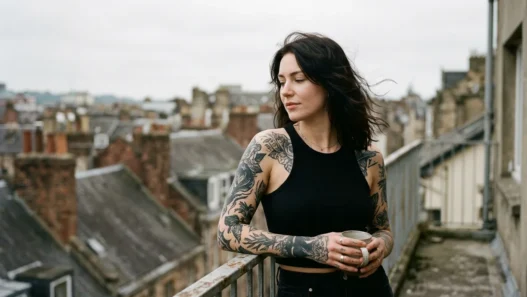
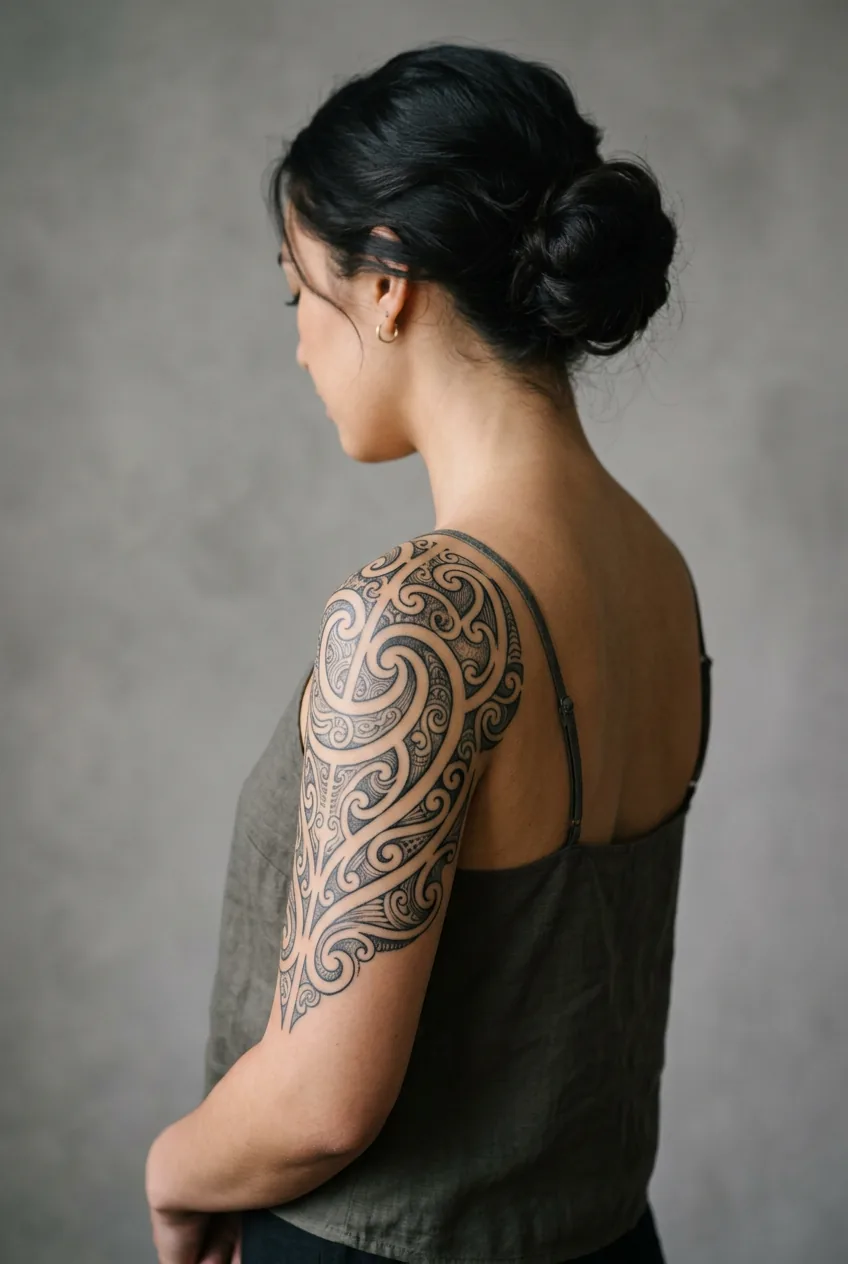
Batok is the traditional hand-tapped tattooing practice of the Kalinga people in the Philippines, and its revival in contemporary ink culture is something I’m genuinely moved by. The geometric bands — stacked lines, diamond forms, and angular hatching that wrap the forearm — are stark, bold, and absolutely timeless. On women especially, there’s something about the contrast of this ancient geometric language against modern life that I find stunning.
This connects beautifully to geometric tattoos as a broader style, but batok specifically has a cultural depth that pure geometric abstraction doesn’t carry. Worth distinguishing.
What I tell clients: If you have Filipino heritage, this piece carries extra resonance. If you don’t, come in ready for a real conversation about intention, and I’ll help you arrive at a design that honors the tradition without appropriating it carelessly.
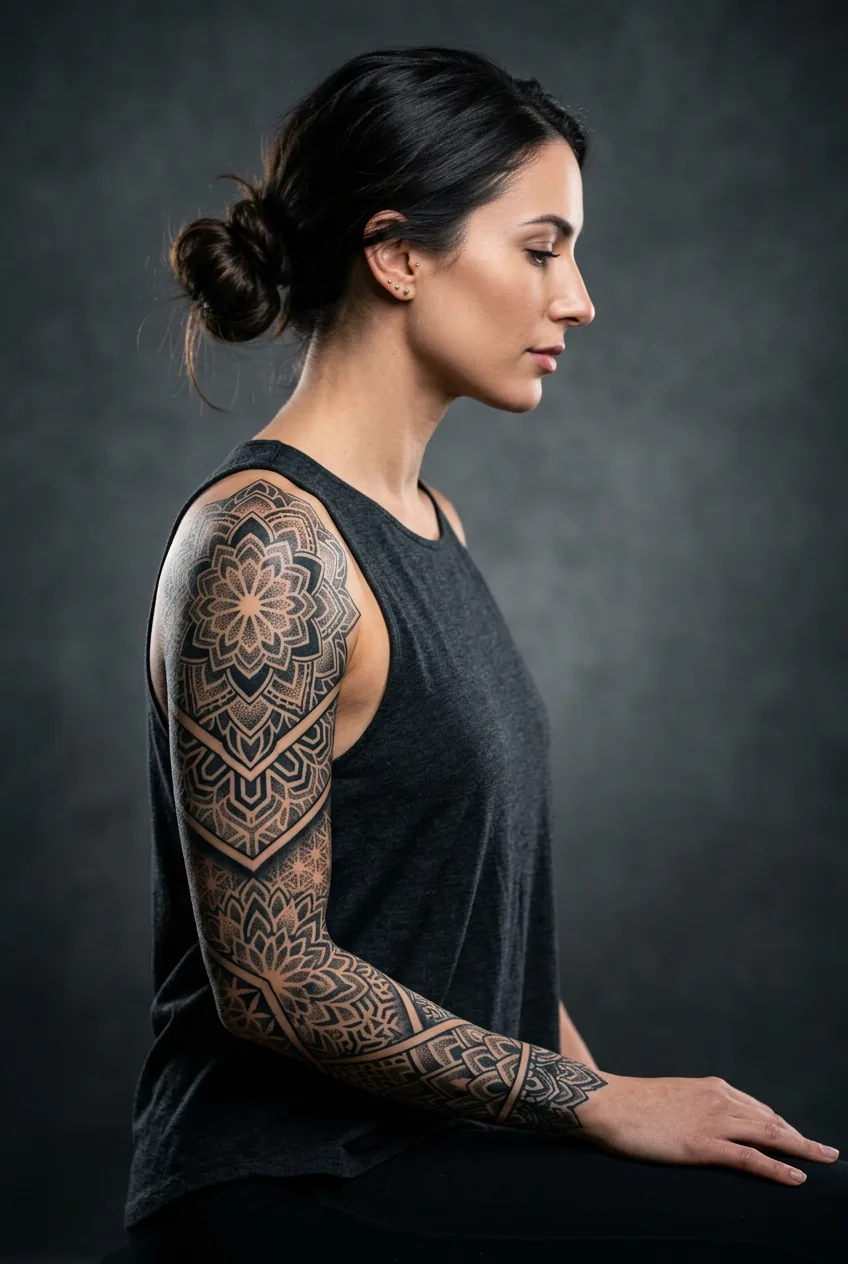
4. Great Idea, Tricky Execution: Full Blackwork Geometric Sleeve
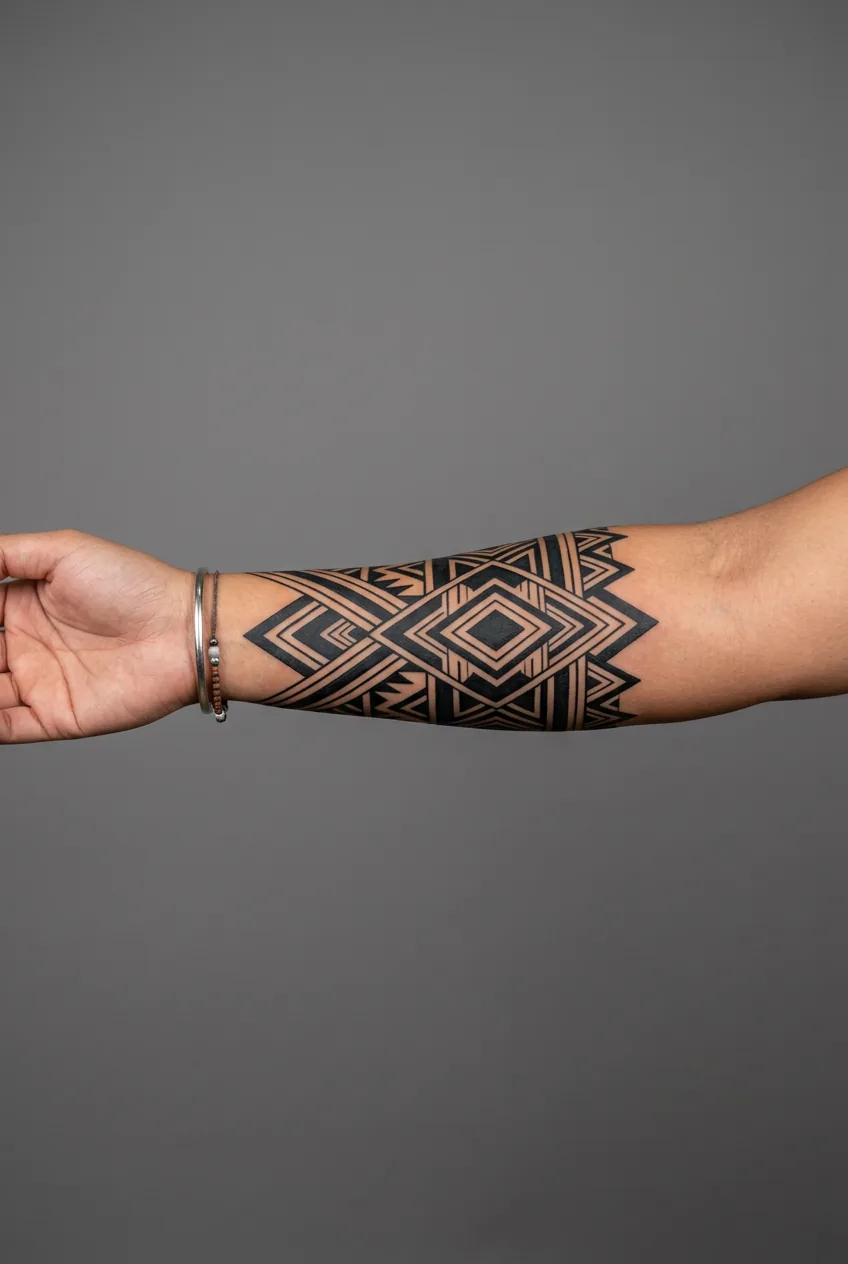
I love these conceptually. A full sleeve built from tribal-influenced geometric shapes — bold black fills, negative space lines, angular patterning that flows from wrist to shoulder — looks incredible when it’s done right. And that’s the catch. Done right is a very specific destination.
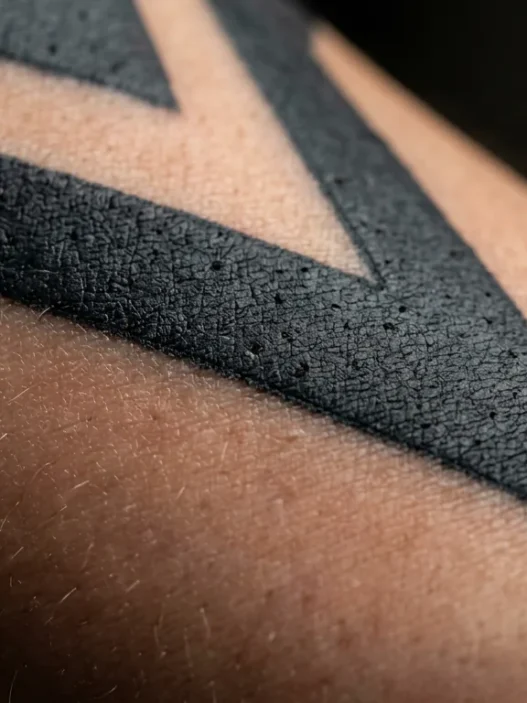
The tricky part? Consistency. A sleeve that takes multiple sessions needs to maintain perfectly even black saturation across skin that heals differently at every stage. I’ve seen sleeves where the first session is flawless and the third session, done by a different artist or rushed, has patchy fills that ruin the whole visual effect. You can also explore traditional tattoo styles as a reference point — traditional work has survived decades precisely because its bold lines and solid fills age reliably, which is worth studying before committing to a blackwork sleeve.
What we change about the brief: We almost always build in planned rest areas — sections of natural skin — rather than trying to fill every square inch. The breathing room actually makes the geometry pop harder.
5. Great Idea, Tricky Execution: Borneo-Inspired Throat Piece
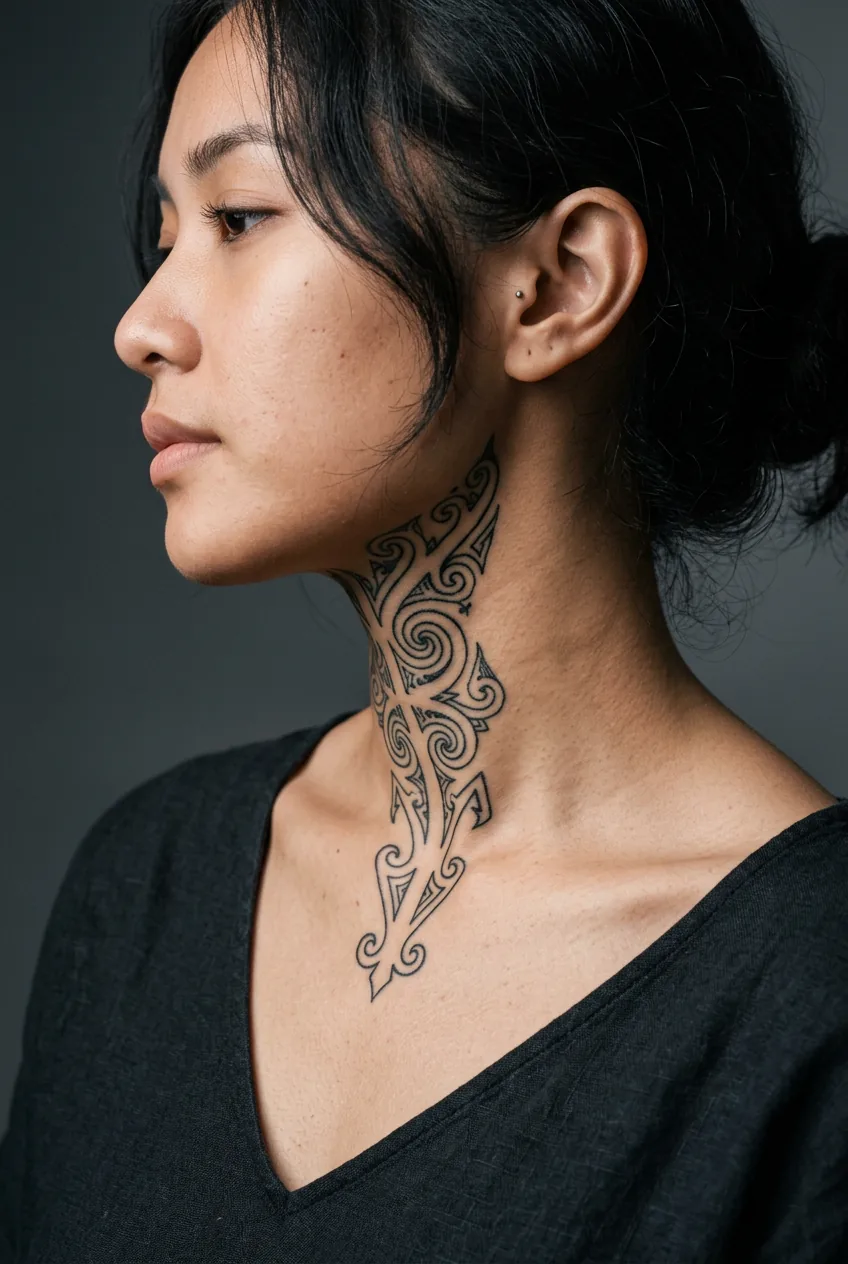
Dayak tattoo motifs from Borneo — the spiraling hooks, the stylized hornbill imagery, the interconnected angular forms — are extraordinary. And on the throat? Dramatic. Powerful. The kind of placement that makes people stop talking mid-sentence.
But I want to be straight with clients who ask for this: the throat is one of the most challenging placements in the body. The skin moves constantly. It ages differently than almost anywhere else. And the visibility means you will never not have this tattoo — at a job interview, at your grandmother’s birthday, every Tuesday morning. That’s not a reason not to do it. It’s a reason to be completely certain.
What I tell clients who ask for this: I ask them to spend six months with a placement sticker or temporary tattoo first. The clients who come back after six months are the ones who get the best results — because they’re ready.
My personal pick for 2026? The Samoan Pe’a-inspired thigh wrap. Every time I finish one, the client cries. In fifteen years, I haven’t gotten tired of that.
6. The Sleeper Hit: Aztec Sun Sternum
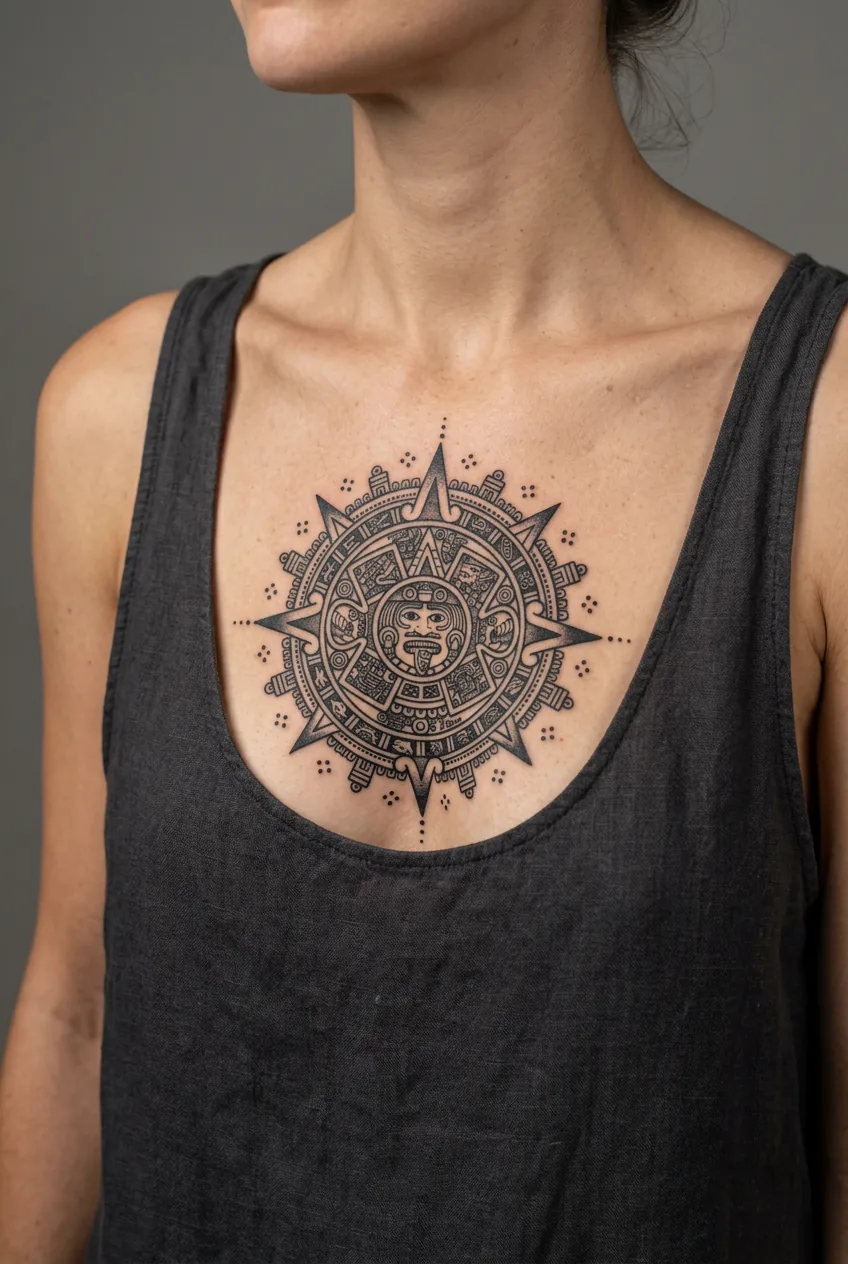
Nobody comes in asking for this specifically, but every time I suggest it in a consult, the client’s eyes light up. An Aztec sun stone adapted for the sternum — centered, radiating outward with angular rays and glyphic detailing — is one of those pieces that looks like it was born on that exact spot. The sternum’s natural vertical line gives the composition an anchor that makes the design feel inevitable.
The Aztec sun carries extraordinary symbolic weight. Tonatiuh, the sun deity, represents cosmic order and cyclical time — which for a lot of women translates into something deeply personal about resilience and rhythm. Check out the broader world of mythology tattoos if you’re drawn to designs with this kind of symbolic density — there’s a whole universe of options that don’t get nearly enough attention.
What we change about the brief: We usually strip back the detail in the outer rays. Less is genuinely more here — a cleaner ray structure heals crisper and reads bolder from across a room.
7. The Sleeper Hit: Hawaiian Honu Back Panel
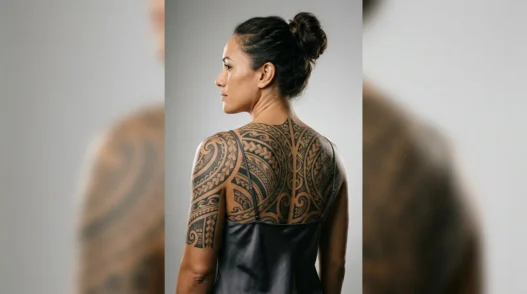
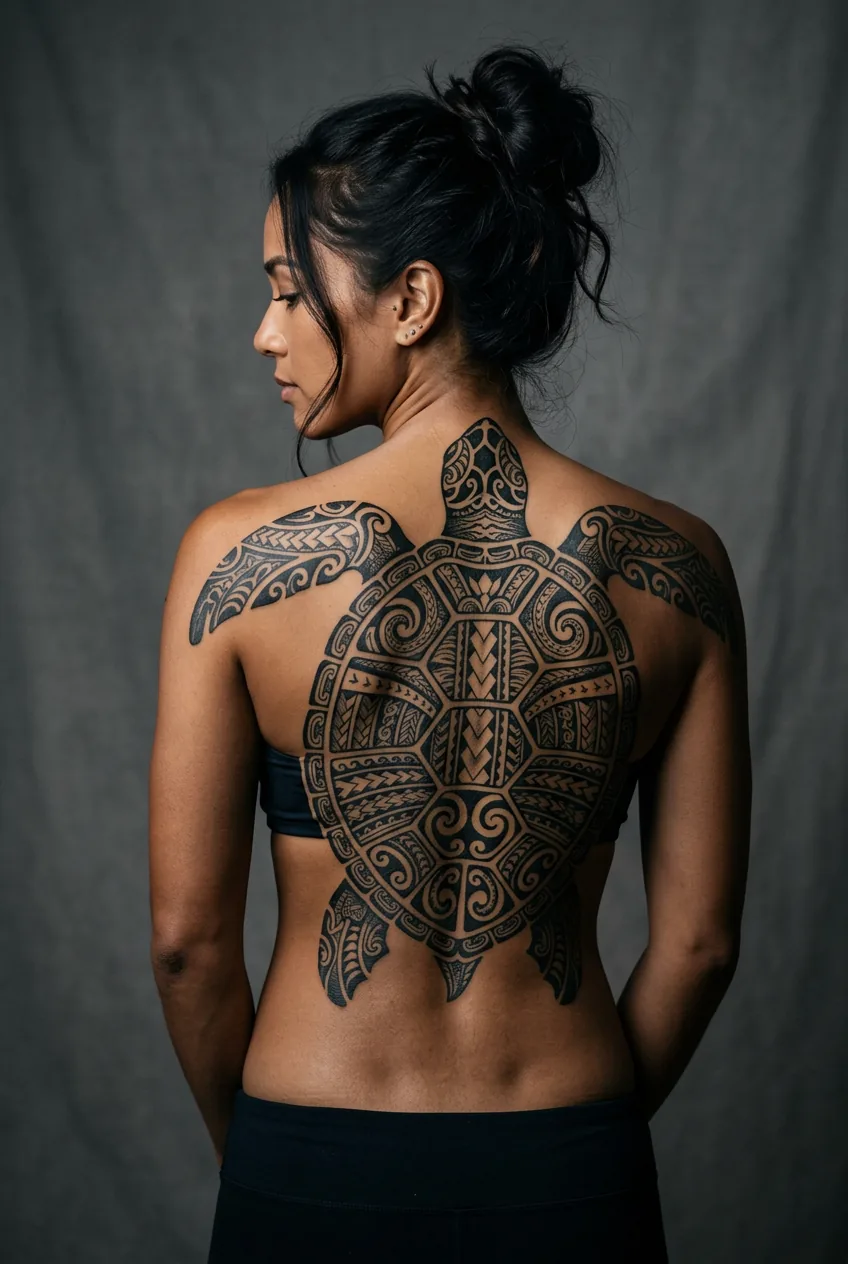
The honu — the Hawaiian green sea turtle — is so tied to Hawaiian visual culture that it risks becoming a cliché. And yet, done with real tribal patterning inside the shell panels rather than a decorative outline, it becomes something else entirely. A large-scale back panel built from traditional Hawaiian design vocabulary, with the honu as the structural frame, is genuinely one of the more underrated pieces in contemporary tribal tattooing.
This also pairs beautifully with animal tattoos as a category — there’s something about animals rendered in tribal geometry that gives the piece permanence. You’re not just tattooing a turtle. You’re tattooing the relationship between living creatures and the cultural systems humans built around them.
What I tell clients: The back is a long commitment. Budget for at least three sessions, maybe four. But look at her back piece in the photo — see how the shell panels create their own internal landscape? That’s what patient, committed tattooing gets you.
8. Worth Every Session: Samoan Pe’a-Inspired Thigh Wrap
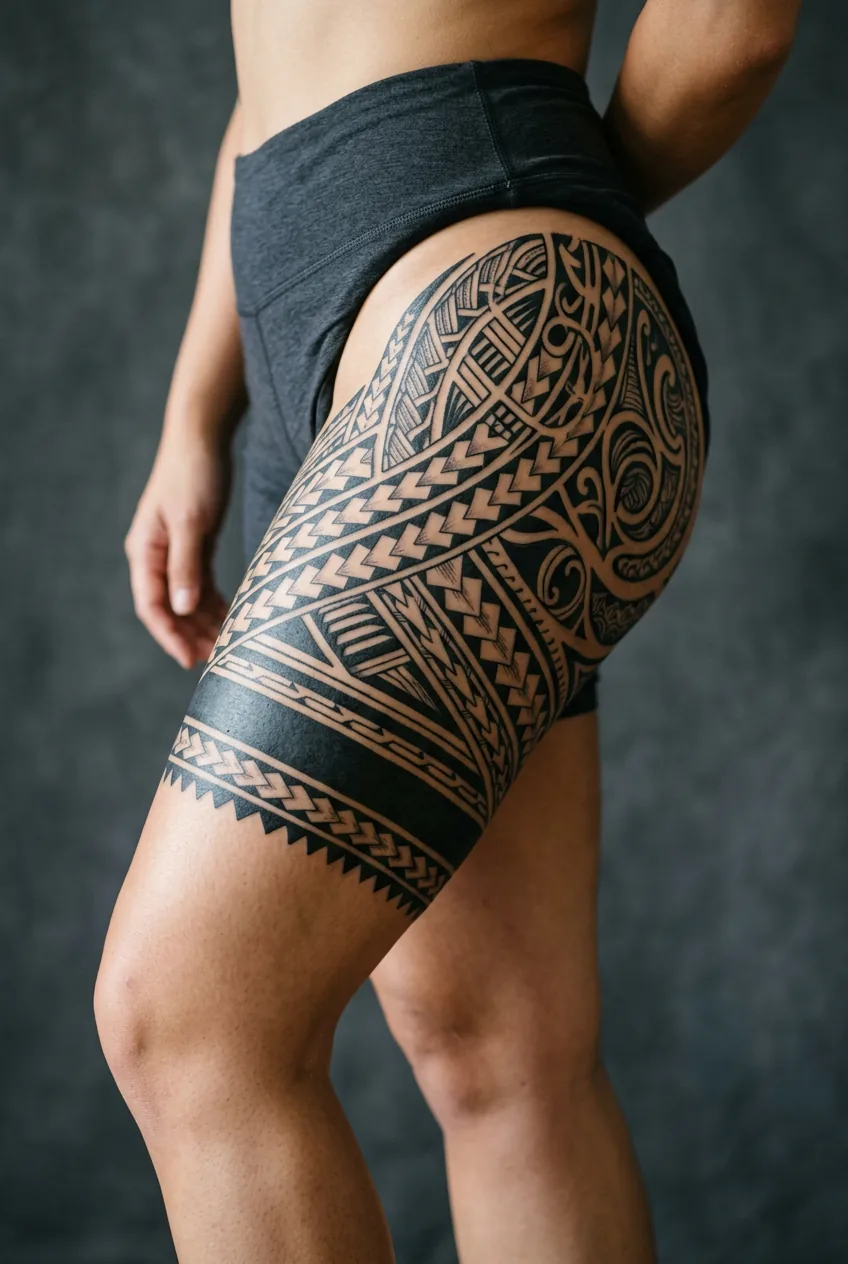
This is my personal favorite to execute. The pe’a is traditionally a full-body male tattoo in Samoan culture, but contemporary artists — especially in collaboration with Samoan practitioners — have developed women’s adaptations (the malu) and further feminine iterations that draw from that visual language for thigh placement. The bold black bands, the flowing curved geometry, the density of pattern that shifts from solid fill to delicate lattice — it is, simply, one of the most beautiful things you can put on a human body.
The thigh is an exceptional canvas. It’s wide enough for genuine compositional complexity, it wraps naturally, and it’s visible when you want it to be and covered when you don’t. The combination is almost unfair.
What I tell clients: Do your research on Samoan tattooing history before we meet. I want you to understand what you’re drawing from — not to gatekeep, but because that knowledge makes the design process genuinely richer. You can explore traditional Pacific tattooing practices to get started. When you arrive knowing the difference between a pe’a and a malu, we can have a completely different level of conversation.
9. Honestly, Skip This: Generic ‘Tribal Armband’ Flash
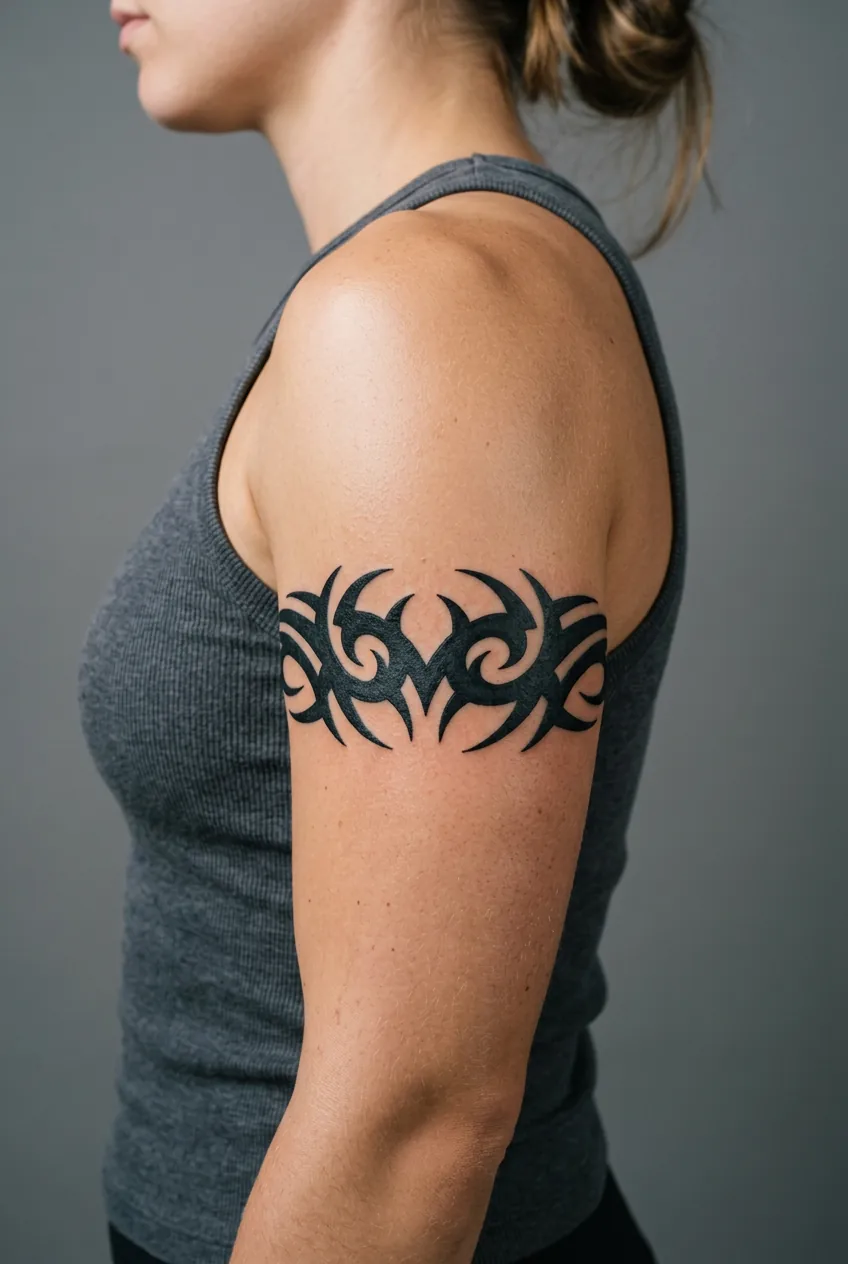
I have to be honest. The generic tribal armband — the one that’s been in every walk-in flash binder since 1998, with its swooping spikes and symmetrical repeat that belongs to no specific cultural tradition — is the one piece in this entire genre that I consistently try to redirect people away from.
It’s not that the design is offensive. It’s that it’s a costume. It borrows the visual vocabulary of genuine tribal traditions without any of their meaning, their history, or their structural logic. You end up with something that looks dated within a decade and carries no story worth telling. I want every piece I put on someone to be worth telling a story about thirty years from now.
What we do instead: If someone comes in wanting a bold black armband, I’ll steer them toward actual Bornean or Polynesian band structures — real cultural geometry with documented meaning. Same visual energy. Completely different substance. The difference in how the finished piece feels is not subtle.
10. Honestly, Skip This: Copy-Paste Pinterest Tribal Hibiscus
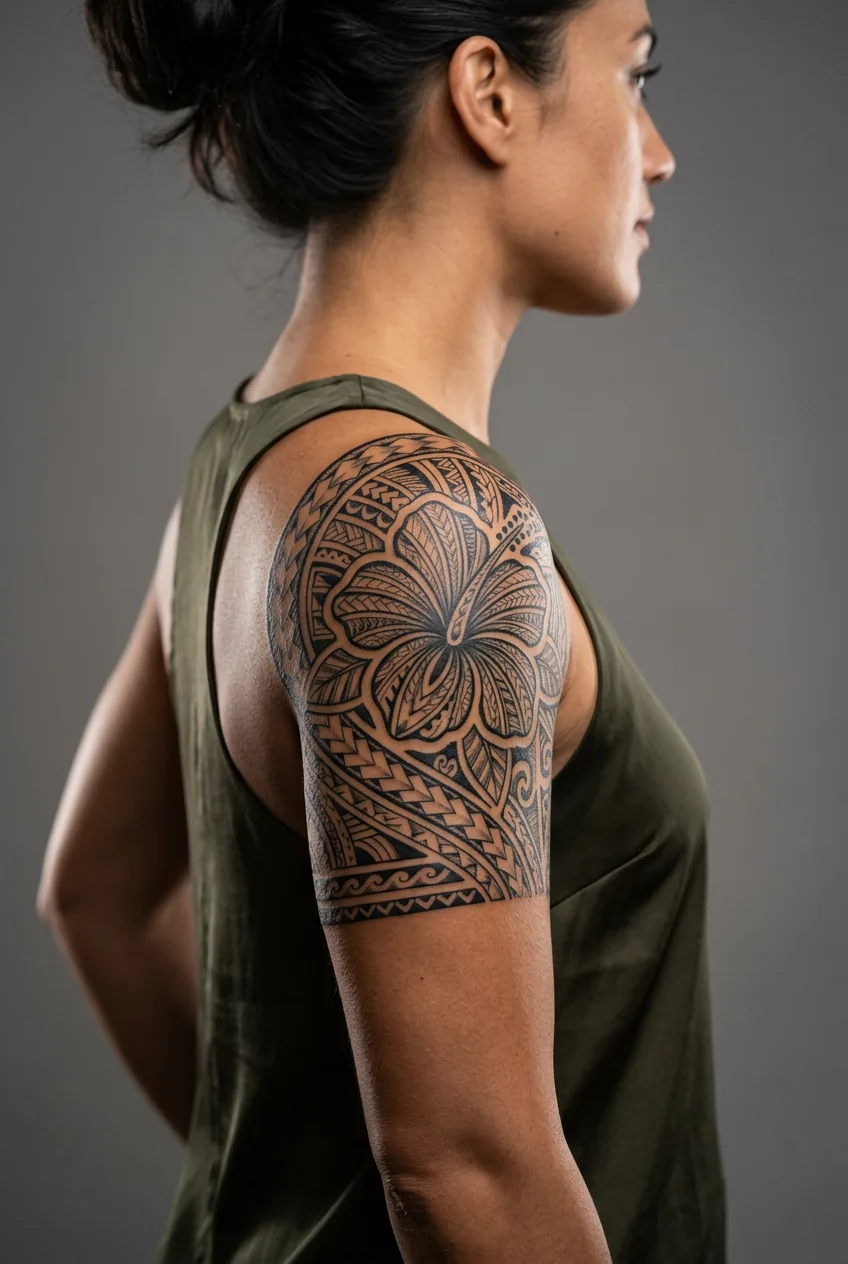
The tribal hibiscus. You’ve seen it. A hibiscus flower outlined in thick tribal-style lines, sometimes with a few geometric spikes radiating outward, no specific cultural origin, just… vibes. And I say this with genuine warmth: I will not tattoo this design as presented.
It’s not about being precious. It’s about the fact that Hawaiian and Polynesian floral motifs exist — and they’re extraordinary. The hibiscus in traditional Hawaiian visual culture carries its own authentic design language that looks nothing like what circulates on Pinterest. Give me a client who wants a hibiscus with actual cultural grounding and I am all in. A well-researched artist can build something around the Hawaiian hibiscus that’s genuinely rooted in Polynesian design principles, not just tribal aesthetics used as decorative trimming.
What we change about the brief: Everything, essentially. We start over from the flower’s role in the culture and build outward. The result looks almost nothing like the reference image — and clients consistently prefer it. You can also browse deeper into mandala tattoos if you love intricate, culturally-inflected geometry but want something that sidesteps appropriation concerns entirely — it’s a genuinely rich alternative route.
Questions I Get Asked About Tribal Tattoos
Is it cultural appropriation to get a tribal tattoo if I’m not from that culture?
It’s a genuinely important question and I’m glad people are asking it. The honest answer is: it depends enormously on which tradition, how the design is approached, and whether the artist you work with has real knowledge of and respect for that tradition. Getting a generic “tribal look” design is different from working with an artist who specializes in, say, Filipino batok and actively collaborates with practitioners from that community. Do the research, have the conversation with your artist openly, and let that guide your brief rather than shutting the whole topic down.
How do tribal tattoos age compared to other styles?
Tribal work — done in proper bold black lines and solid fills — ages beautifully. It’s one of the most forgiving styles over time because there are no delicate fine lines to blur and no color to fade unevenly. The key is that those fills need to be fully saturated from day one; patchy black is the enemy. Ask your artist how blackwork tattoos age before you commit to placement, because some spots (like the inner arm and feet) are more prone to fading regardless of style.
How many sessions does a tribal piece typically take?
A small forearm band might be a single four-hour session. A full back panel or thigh wrap is more realistically three to five sessions, spaced six to eight weeks apart to let each stage heal before adding more. The density of black in tribal work means your skin needs genuine recovery time between sessions — rushing it produces patchy fills that are difficult to correct.
What should I bring to a tribal tattoo consultation?
Bring reference images, yes — but also bring any research you’ve done on the cultural tradition you’re drawing from. The clients who walk in with a saved article or a book they’ve been reading get the best custom work, because there’s a shared vocabulary to build from. And bring any personal meaning you want the piece to carry — the best tribal designs aren’t just beautiful, they’re about something.
Tribal tattooing is one of the oldest art forms humans have ever practiced. When it’s approached with the seriousness it deserves — with real artists, real research, and real intention — the results are extraordinary. And when it’s rushed or genericized, it’s just a missed opportunity. You deserve the real thing. Go find an artist who’ll give it to you.